Wasted frames

I am forever testing lenses. I used to line up a camera with a book case in our old house and test all of the extremes of focal length, aperture and frame area, turning a chore into a bit of an art form. Lately the method has simplified to just taking some snaps of consistent subjects and viewing at normal size on a biggish screen. A waste of a frame really.

Poor Pepper or, as we also call her "Miss Daisy" has been my muse for the last few years since we adopted her from my brother in law. She is very photogenic, patient and has reliable habits as she wanders from room to room following the sun. This day I had the 75-300 in hand and noticed her winding up for a bark at a passing dog. The shot was the usual, aim for the eyes (Olympus eye detect works on dogs!), hold steady and shoot. The result is an image nearly impossible only a few years ago. A hand held 600mm equivalent focal length, indoors in fading light at ISO 400 and a slightly moving subject. The aperture is f6.7 (wide open on that lens and apparently its weakest point...hah!) and the shutter speed was about 1/60-1/125 of a second. IBIS on even the older EM5 is good enough that sometimes you forget old habits and try improbable shots. 
Conflicting emotions

One of the main draws of street photography is observing the interaction of people in their world. Going about their business with little or no awareness of a quiet observer, they show you the faces that often only close family and friends see.

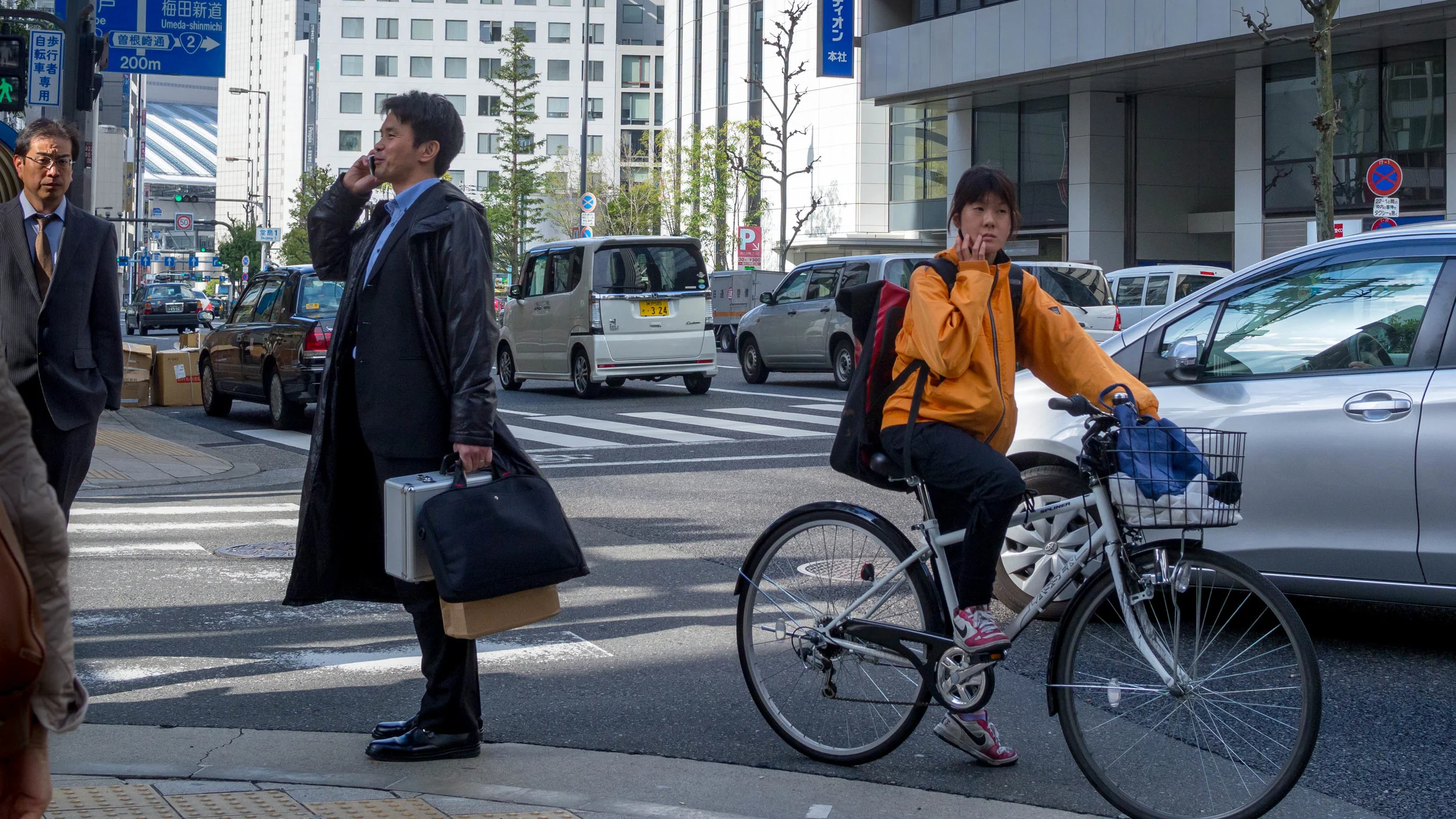
In the same style as the last posting, this photo has been processed with the "cinematic" look to exaggerate the three stories. The sun lit business man, just entering the frame with a look of utmost practiced seriousness, the younger man receiving some good news and the lost expression of the woman on the bike all tell differing versions of a moment in time. I have always been drawn to the works of National Geo, Magnum and the early street shooters for this reason. They wanted humanity to open to them, spontaneously and honestly, something that is becoming ever less attainable in modern life. Everyone has a story, everyone has a life that is theirs, but a small insight into their world can make ours richer as long as no harm is done. 

The camera was again the EM5 and the 25mm f1.8 set at f4. Auto focus was used with the central focus point only and was a little off, so on close inspection the front players are a little soft and the cars in the background are sharper. From then on I trusted the face detect and wide area focus system more for this type of work. I have a habit of walking out the door with a wide or normal lens and short telephoto. This day I chose the 25mm instead of the 17mm and found most of the images taken had a tighter tension to them and were technically harder to take. I had more hits that day, but also more misses.

Cinematic echoes

Almost as important as taking a photo is presenting that image the way you want to get your vision across.   

The above image, taken in Osaka last spring, attracted me because of the layers of different people, but I struggled with its presentation. Something was missing from the image's look. It reminded me of something, but I could not put my finger on it. Then one day a friend said "it's kind of cinematic. like the cast of Reservoir Dogs on a promo poster", and so began the cinematic experiment (basically semi panoramic aspect with rich colours, selective focus and dramatic light). Not many images work for it, but when they do, nothing else seems to do. It's easier to do with a lens over 100mm (full frame) as that mimics the compression of cinema better, but can be accomplished as this one is with a wider angle. The confident guy with a cigarette and his friends, the disinterested delivery man, the dog attached to an invisible owner, the yellow cab filling the blank space, the evenly spaced colour points and the slightly hurried looking business man work as the main characters in an untold story. 

The camera was the OMD EM5 and the lens the 25mm f1.8 at about f4 (50mm at f8 on a full frame), using autofocus with face detection. I love the light in Osaka. Its brighter and clearer looking than Tokyo, especially around the newer buildings near the station.

Hail Mary

Technical perfection is apparently overrated (says my wife). So against my better judgement, some images get printed....big and hung on a wall in our house. Some would not make it off the "cutting room floor" on a purely technical basis, so it's a good thing my wife practices what I preach about image content over technical considerations.

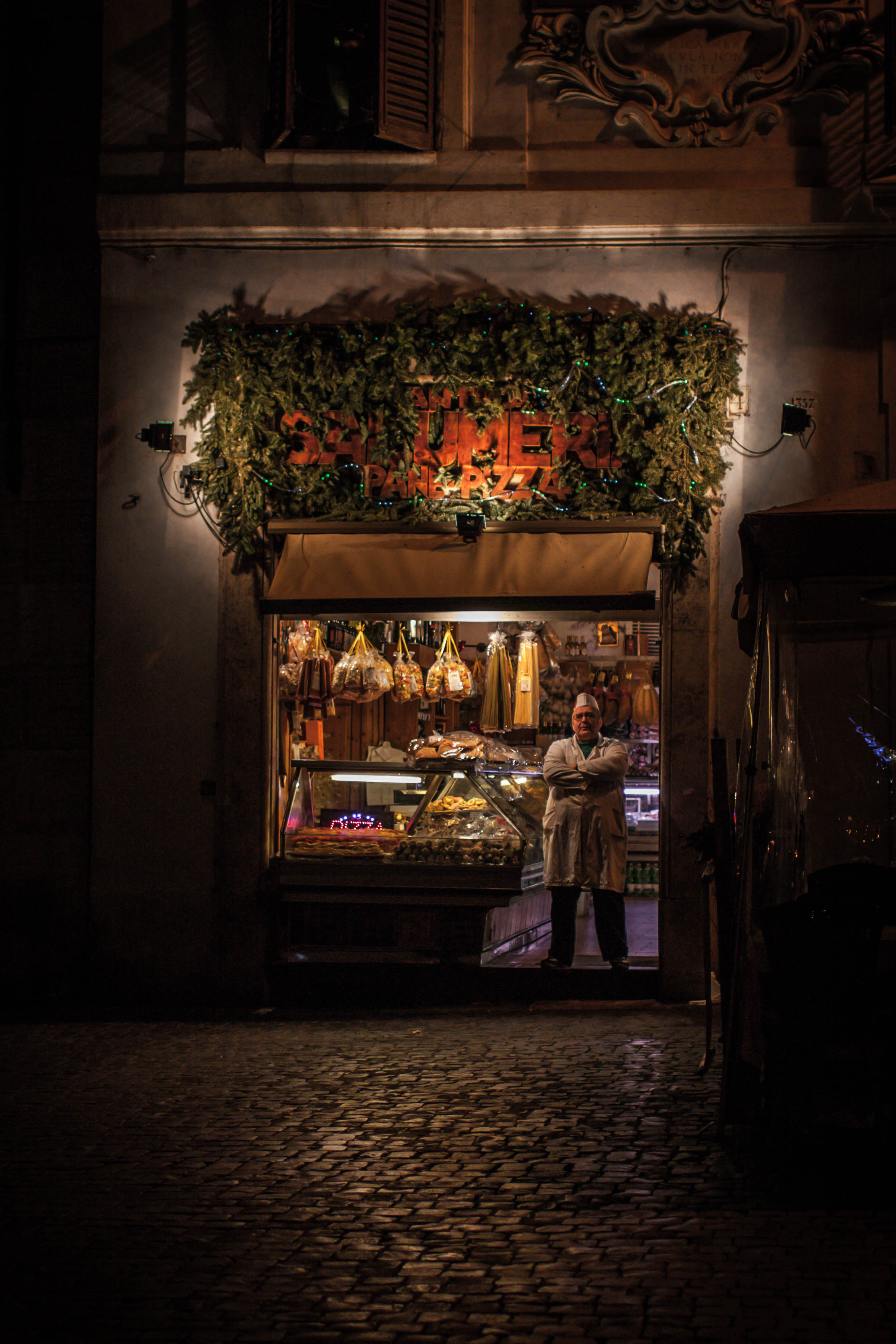
The image above is heavily cropped, poorly exposed and a bit soft, but it's a household favourite and prints quite well. Taken with a 450D canon and a 35 f1.4L lens wide open at about 1/20th of a second, holding an icecream in one hand, sitting on the freezing steps of a fountain in Rome, in January, it should not really have happened. It happened twice (the image in galleries is slightly different). Looking at the original file is not heart warming. I learned a lot about the limits of Lightroom and the 450D getting something useable out of it, but it's ok and hey, I like the image when I don't think too much about its flaws. 

Tough light, tough crowd.

Some places are beautiful and some photogenic. Sometimes the two are less than harmonious.

The Fushimi-Inari temple in Kyoto is a must see on the tourist calendar. A short, pleasant train ride from the main station and popular with tourists and locals, it is well frequented any day of the year. As with most temples in Japan, it is a working religious site as well as a nice place to be. 

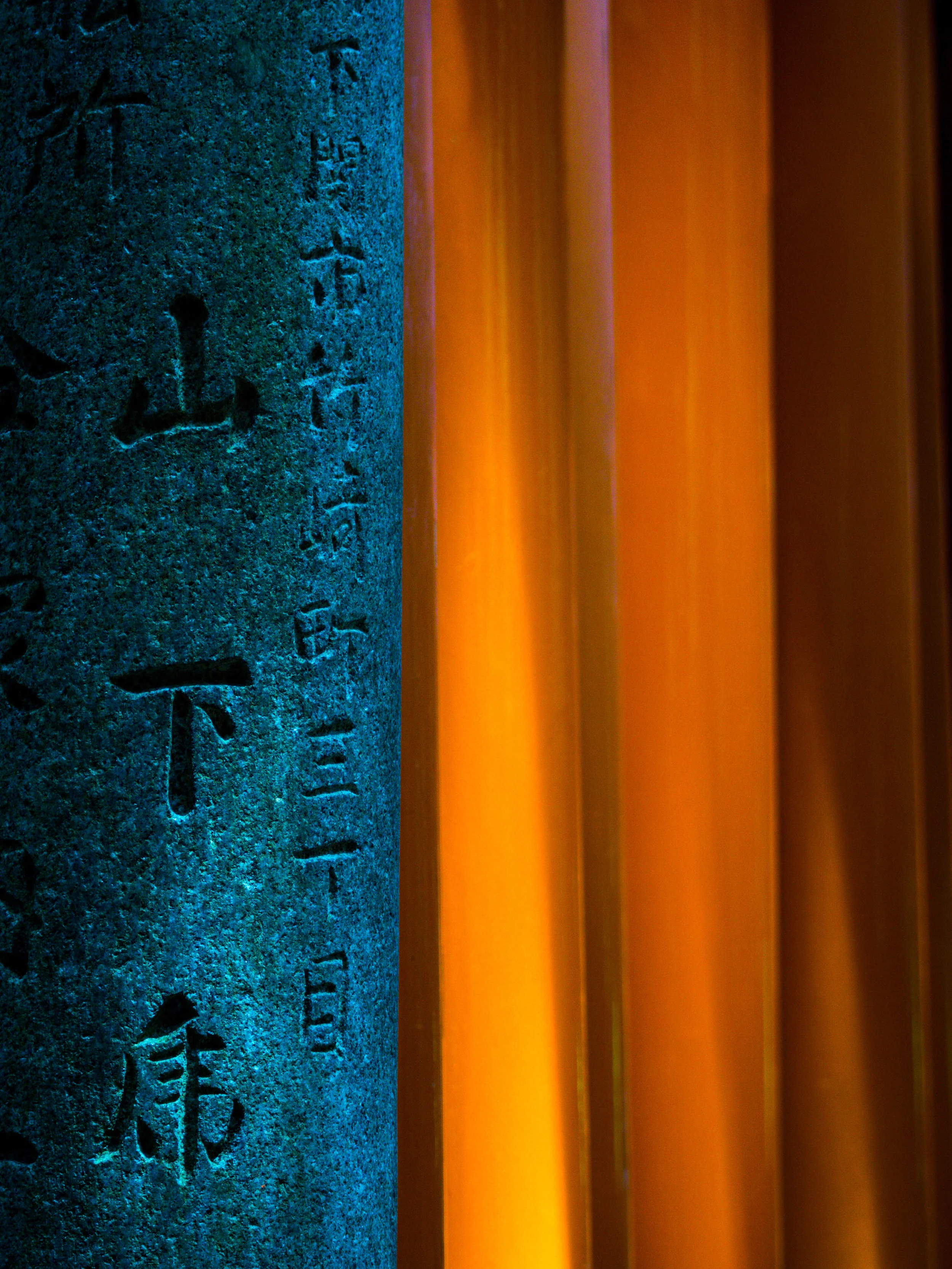
We arrived mid morning in spring to an already solid crowd and it was building. The temple area is spread across the face of a large hill, broken into several circuitous routes, allowing people to see some or all of the pathway as they wish. As we climbed higher the crowds thinned, but it was still nearly impossible to get an image of the hundreds of orange gates without an unwanted element in the frame and the light was at times harsh and too direct. Resorting to compression and tight detail, using a 75-300 at the short end and wide open (f4.8), I compressed the cold stone detail against an almost silk like wall of orange flame. The bokeh of the 75-300 is very nice for a slow zoom lens and it occasionally made/saved images on the trip.

Lemons and the Kremlin

Every image you make draws its inspiration from sources that may go back a long way to your earliest memories. This is what makes us unique.

One of my earliest inspirations is the work of Sam Abell of National Geographic fame. Abell's work had a couple of things that drew me irresistably. The first was sublime balance and harmony, both things that all photographs require at some level. Secondly a "back to front" compositional style that emphasised all of the image elements, not just the main subject. His Montana ranch cow branding image is one of the best examples of his style and the effect colour has on the perception of depth in an image. 

When given an assignment to photograph Russia and specifically the Kremlin, Abell chose to compose the photo through an open, lace adorned window being used to ripen lemons. This had the effect of context for the Kremlin building in the life of the ordinary Russian. Brooding, mysterious, beautiful, but also just "there" as things are in daily life everywhere. I must admit to not getting the image at first, but it grew on me as the better ones do and is now a firm favourite.

Taken spontaneously while chatting with my wife in our tiny hotel room in Tokyo with an OMD EM5 and the Olympus 45 f1.8, the above image meant little during taking, it was just a careless warm up shot to check settings and the battery. When reviewed it reminded both of us of that Kremlin image in tone  and style (Olympus cameras have nice "filmy" colours, a bit Kodachrome like). The aperture used was f2-2.8 (roughly a 90mm at f4 on a full frame) due to the light in the room, but I left it there in response to the soft rendering of the background image. The curtains are razor sharp, but the woman in the background is almost entirely up to you to interpret, giving you the "idea" of her life without the detail that would stifle imagination.