Generic RPG’s are a terrific way to enter the TTRPG hobby, but they can also be a bit of a double edged sword.
On one hand you have any world (universe, alternate reality) at your finger tips, on the other hand you have to colour in the world picture yourself, sometimes even draw the lines.
I have found that quite often, generic games draw me in for their flexibility, their promise and their lack of constraints (hate constraints, but like guide lines with flexibility). I think that a free-form structure-less structure is my ideal.
The problem is, I usually stall at the creative bit, not because I am lazy (well, not only), not because I do not have any decent ideas, but because I often do not know where to start, where the lines need to be drawn.
The BRP UGE is a prime example. It, like most generic games, has tools to help, but I find it hard to commit, ironically often turning to the ready made worlds on the larger system tree like Cthulhu or Runequest.
Generic RPG’s often struggle to give you character, a feeling of the type of game they are capable of providing without leaning too far one way or the other. Savage Worlds is a good example of a generic game that claims to be able to do any genre/mood/style, but is actually better at providing a pulpy style to basically any period, other styles are very much down to player and GM pay-in.
The BRP UGE in contrast is better at realistic simulations. You can push either peg into either hole, but why force it?
This also realistically leads to some generic systems simply not being able to do some things well. Want to play a Guardians of the Galaxy style SciFi game, then Savage Worlds rocks. Want to do something more grounded like Tales of the Loop where action is less dynamic, but more threatening? Best look at a game like M-Space (Mythras) or BRP.
A themed game saves you much of the creative brain work, but paints you into the corner of having to learn its lore, adhere (mostly) to it’s requirements and tell your stories against a fleshed out backdrop made from another’s imagination.
Like most people I often come up with ideas when reading other peoples works.
I find alternate roads, ones that better suit me, but rarely find a perfect “as written” work. This is often rule zero of a game, the reality that players and GM’s will stray, so no issue really, I guess it is just a matter of where do you accept and where do you create.
Do I need to remake structure rather than build from the ground up to be truly free?
This tends to work best when you already like the theme, such as Tales from the Loop or Tolkien, but it can be a compromise in the worst way if the theme jangles and the mechanics are not worth the effort or worse, you break what you like.
My advice to myself, and to others if it helps, is to start small. Everything great started small by the very nature of things.
This is how we used to play. Small adventures with small characters that explored their world as it and they evolved into larger entities.
This is how Forgotten Realms or Runequest started, with a village, then a nearby forrest or row of hills housing a temple or ruin, then maybe a nearby city, a kingdom, then a continent or even another time or dimension and so on.
Savage Worlds is ideal here.
This system allows the players to start creating the feel of the game they want to play from minute one, the GM guiding and learning from them equally. The world, it’s parameters, its limitations will set themselves as they go, the massive depth of loosely themed companions are just there to draw from.
I have looked at several of the more themed sets like Deadlands and chosen against going into them, because apart from the price (hard to get in Australia and quite expensive, especially if you get drawn into all the fluff), the baked in theme does not hold me. I like SW for it’s “write it as you go” generic nature.
Sometimes though, worlds collide in the best way.
Haunted West popped onto my radar today, while circling Scum and Villainy and Electric State on a local website (Campaign Supplies), two game styles I know I can do with systems I have (Traveller, SW or M-Space), simply by adopting the theme and going from there.
Some games, as lovely and polished as they are, are really only a one-shot engine or short campaign at best. Other systems can mimic their domain without such constraints.
Anyway, back to Haunted West.
It is a D100 game, with the system modernised in the ways I like. It is much like Deadlands, but without the supernatural baked in so heavily to the theme (it tackles everything from ancient European Horrors to Aliens, but all are optional and their level of influence is up to the GM).
It also tackles a lot of mature themes maturely and it has a ton of background. Finally it also allows several play styles from crunchy miniatures and measurements to mostly narrative play.
It was a reflex buy and I anticipate its arrival immensely.
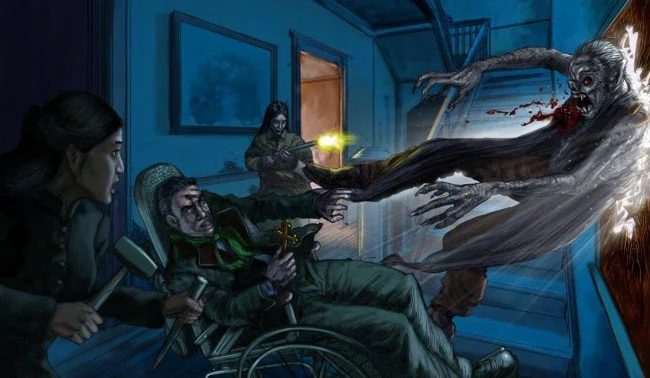
A little of this and a little bit of that, but nothing too heavy handed, almost a themed generic game.
The secret sauce was a generic enough game with a not overly opinionated theme, well produced and deep (800+ pages), well priced at less than twice the price of your average book (or as it goes, a single SW companion in Aus.) with more than twice the content, and an improved version of a system I like with play style options.
It is all in the mind I guess.
I tend to stumble with generic games through analysis paralysis and grind to a halt with themed ones faced with a wall of pre-made stuff I want to do differently or were simply insurmountable walls of text like the Iron Kingdoms RPG (with 100 pages of history up front). The trick is of course, to just play and let it work itself out.
Commitment to creativity is the key, setting boundaries and focussing on them is the lock.
When do generic games shine?
When the theme, no matter how compelling, is probably not enough to hold a full system or longer, deeper game. An argument could be made for example, that Mothership or Electric State are both games that are built around a single premise, one the space hulk monster hunt, the other a road trip across a perilous land. Both could easily be done as a single scenario in a bigger game, but that brings us to what makes themed games different.
Themed games are usually tighter and more on point.
Looking at the two mentioned above, they shine as one-shot games, the mechanics are honed to the theme, the theming itself is myopic, Mothership excelling in dark fatalism, Electric State feeding off the excellent inspiration provided by the book.
Simulating Mothership with for example M-Space is perfectly possible, nearly ideal even, but you need to set the scene and look to the rules for options. Electric state is much the same, M-Space could do it and Tales from the Loop or even The Labyrinth (a later book). There is of course a sub-theme effect of generic games.
Savage Worlds could cover a Mothership-style scenario, but it would be hard to avoid either a nihilistic or pulp-comedic vibe, because the mechanics promote that. It would be possible to darken the mood (as prescribed in the books), by removing some of the elasticity of the system, but it needs to be overtly done.
M-Space is already a harder, more realistic and therefore less forgiving game so it could be easily shifted to Mothership style, just adopt a Call of Cthulhu mentality, one where survival is not guaranteed, the adversary is not a push over or even beatable. It might even be a better game as the players may go in with a less “doomed” frame of mind from the start.
So, a good generic game is not only a decent set of flexible and comprehensive rules, but it must also be good at adapting to different themes. This is tough as art, font, previous history and any built in bias, intended or not, will influence the user from page one.
For me it often starts with a single picture.
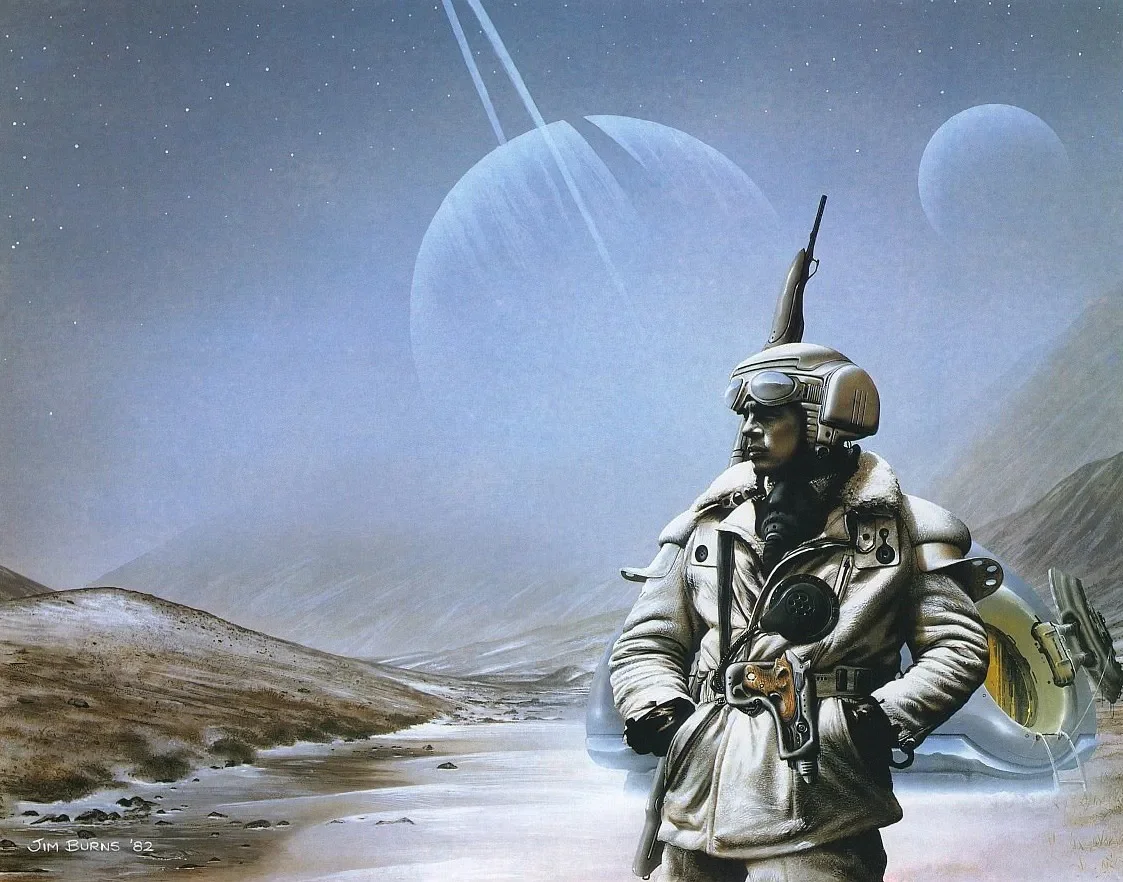
A Jim Burns work from the 70’s. Plenty of inspiration here.
Ed. I have just purchased a second hand copy of the Cortex Prime system book. I was not in the mood or head space for more systems, but this one has me intrigued. The system is not only a generic set of rules, but a “building block” game system.
You actually design the game around the theme you want to support and it has a proven track record with games like Marvel Heroic Role Playing (A game I have what little was published, but it has no char-gen rules) and Firefly, a favourite series and a theme I had in mind with my hunt for a good SciFi game. I was never interested in Smallville, but I now get that that very asymmetrical dynamic could only be handled well by a handful of systems and this is one of them.
It uses a Savage Worlds style dice range in small pools, but the characteristics, groups of important stats, skills, affiliations, special abilities and motivations are up to the player and GM to design to suit the game. Want a game heavily influenced by interactions (Delta Green, Reign, Tale from the Loop), then add them and name them as suits (family, self, friends or company, state, family).
I have a feeling that the creative stall I suffer from is rooted more in setting the feel of the generic game than anything else, Cortex Prime sets the style in char-gen, so it may well fix that.
It also seems to be probably the easiest game to port other games across to, like Tale, or Electric State and adds the char-gen rules needed to add characters missing from their unfinished Marvel game.
Is this the ultimate any genre, any style, any mechanical platform game? We will see.