My eternal quest for, or more accurately inability to decide between ECW rule sets is ongoing.
The main issue is committing to a basing style that fits with a chosen game system without limiting future changes or dissatisfaction with rule set “A” over “B”. My WW2 rules vexations are similar. Weighed against this is the need to get on with it.
The ECW period has been a problem from day one, which is interesting as I actually have forces fielded in two scales, 15-18mm Museum and 28mm Redoubt, so I have two chances to stuff it up…. !
Rules I have looked at (and own).
Big and glossy, lots of eye candy, but lacking what I need.
WH ECW is too…. Warhammer. I can still do it with either scale, but it lacks the right feel.
Pike and Shotte is too big and also fails to feel right. I can do it, but likely will not.
1644 is another beauty and nice to flick through, but unfortunately I do not like the rules.
The Kingdom is Ours were interesting, but not a contender apart from their eye candy. I may be one of the few gamers I know who own enough dice! Lots of eye candy even if an advertising forum for the publisher.
Field of Glory; Renaissance, is probably the modern equivalent of Forlorn Hope or advanced DBR with lots of polish, lots of books, but without the character. Being a rules heavy and rigid set of rules, no temptation there. Beautiful books, a long way from my happy place, but I bought them (lots of them) cheap on clearance the lists and pics are excellent.
Old school, for better or worse (mostly Pete Berry titles).
Forlorn Hope is close and a favourite of many, but a bit old-school clunky. A great resource and I have most of the scenario books, which are a great and insightful read for any system.
File Leader is about the right scale, the rules are slim, but needlessly convoluted.
Push of Pike, not bad, light and breezy, but again a little old school.
Once upon a time in the West Country is another old school game focussing on 1:1 skirmishes. Too small a scale.
Outlier ideas, system evolutions, oddities.
DBR may be a 15mm option and I have mounted my 15’s for this out of habit. This surprises me, as I have never really engaged with DBM/DBR, preferring DBA if anything, but this one is starting to emerge as a contender after researching other’s recommendations and I am happy my 15’s are mounted for it. It seems to handle mutual support, depth, the push and pull of these battles and the scale medium to large battles on a regiment as tactical unit basis is perfect (100 men a base, may be scaled down to 50 odd for smaller ECW regiments).
Basically, against all the odds, these rules feel right. One element can go it alone, unit composition is reasonably flexible, but regiments can fight together with support. Attrition and morale are integrated, long lines are discouraged in favour of regimental sized facings (from V1), but formations are possible, depth and flank support are key tactics and (after I rename them), all troop types are covered.
The battlefield also looks suitably messy.
I will give them a more approachable and ECW specific re-write, their legalese style does my head in (not alone there) and there are nuances I can add as well as general classes can be called out for what they are like Clubmen rather than Hordes, Gallopers instead of Pistols-fast etc.
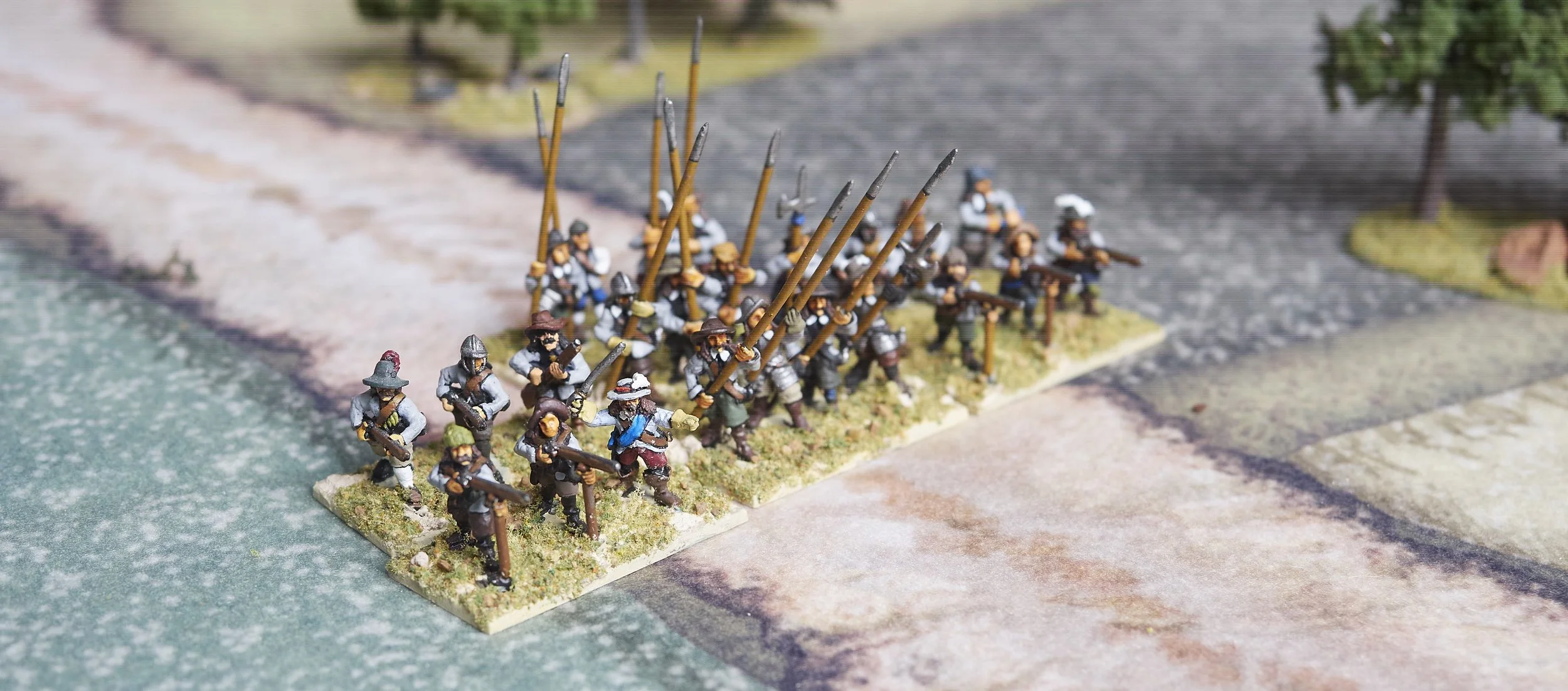
Looks right, plays well. My short list of changes includes shifting scale to 50-70 men per element making this unit above about 350-500 men.
Principles of War Renaissance is an old favourite, possibly a contender for 15mm’s as the armies are a little large (12-20 units minimum) for 28mm figs. Basing is fairly irrelevant, so DBR style works.
Victory Without Quarter a free set (although I own the rest of these anyway) and probably my go-to for larger actions with 15mm figs. Simple and logical, easily hacked, looks and feels right. I can use my DBR mounted 15’s and arrange them as suits on sabot bases.
The Pikeman’s Lament. An Osprey “Blue book” by Dan Mersey, a favourite rules writer* (love Dux Bellorum for Arthurian), these are really close to perfect. The simplification of unit sizes and conditions and the loose to no connection of pike to shot are not insurmountable obstacles, but are there.
Very Civille Actions, another free set is another favourite. The game is about right, mechanically ok, but perfect to scale. It is hackable and has some lovely unit cards. It has element removal (a favourite) and morale is more of a consideration (most units broke before they were utterly destroyed, but it can still happen). The rules are written strangely, almost a Q&A, but they are up for a re-write anyway.
The colonel of an idea for my 28’s is developing somewhere between the two above.
Polemos ECW is another big battle set, but designed for 6mm figs. I can push these into play with my 15’s, but I probably will not.
See a pattern here? Lots of options for battle scale element based 15’s, nothing solid yet for my smaller scaled 28’s.
What am I chasing?
For 15’s I am happy enough with several sets of larger scale battle rules (VWQ/POW/DBR).
For my 28’s scaled for smaller actions in Scotland, Cornwall, Wales etc, I am after something that covers these actions but not at 1:1 skirmish level, something more tactical and situational, but not that small.
I would like to field a full regiment in all its parts with attached supports, but not much more.
My Covenanters for example comprise about 50-60 shot and the same in Pike, 6 dragoons, lancers and gallopers, a regimental gun, some command. About 150 figures give or take, so at say 1:5-10, maybe 750-1500 men, perfect for those important but small actions in far flung places, many of them scantly documented.
These figs also have handling issues, being large Redoubt figs, so factoring in pikes etc, a cumbersome if impressive table presence.
Originally, VWQ was of interest, with POW as an option using large diorama bases. These handle well (although single drop can be a heart breaker), but these are bigger scale games.
Very Civille Actions is closer to right, just needs a few rough edges filed off. TPL added some clever ideas and showed the popularity of these small battles.
One area most small scale games fall down on as written is the interaction of pike and shot, such as sheltering or the “Hedgehog”. This seems to be a trend. The Hedgehog, where a block of pike shelter shot under their pikes, seems to be in limbo with many rules of this scale, meaning pike need to intercede a horse charge or the shot fall back, rather than form the Hedgehog. The fact is, there is a lot of dissent on what really happened in the ECW, how well and how often a Hedgehog was formed if at all.
Basing.
I like 2-3 figs on a round base rather than 3-4 figs on square ones. This gives the unit a more “hodge hodge” feel, with more subtle facing and it is flexible when two pike blocks connect. This is always an issue, large element bases are one fix, setting the pikes back so they do not fight the terrain or other units, but “soft” round edged bases can also fix this.
With round bases, you can form rigid formations (the figures on the base are as important), but you can also adapt to odd terrain shapes, contact with the enemy, less rigid facing and the more realistic looseness of most ECW era units.
Movement trays can also be made with “plugs” for the elements rather than being filled up entirely (or not) by square bases. The bases can also be set at slight angles, looking less rigid and more realistic, almost no illustrations of ECW battles show perfect Napoleonic style lines and blocking. It is a natural reaction for the outer files to curl back in self defence and for shot to shoot at slight angles.
This base limit, also facilitates the benefits of small aggressive Forlorn Hope or assault companies working well in confined spaces.
The VCA rules use square bases, but really, they do not need to and my basing nets me 25% more foot bases.
In TPL, a unit with 7-12 figures gets 12d6, a unit with 6 or less get 6d6. I know this is more of a condition measure than actual casualties, but I struggle with it. Disordered units also get a drop and dropping to 6 or fewer figs assumes disorder, but this 6 to 12 jump is too severe for me, I prefer more incremental drops with morale as a separate thing, so if each base has 3d6 fighting capacity giving a 3/6/9/12 (or even 15/18 with bigger units), it feels more realistic and falls in line with VCA. Basing in 3’s helps facilitate this.
Maybe elements could have varying attack dice depending on their attacks efficiency against different defences (Horse v Pike, Horse v Shot etc). Wheels are turning.
This also helps with situations where only bases that can see/contact can fight (probably 2 deep is the limit, maybe at reduced effect unless pike), like contesting a bridge, cramped street or hedge lined road? It even allows for actual base contacts to be accounted for rather than the looser “all figs are engaged” rule of TPL.
If not, I would actually prefer a more abstract “unit condition” system.
The other thing that is troublesome is the Hedgehog formation. If the unit successfully forms up in one (not guaranteed), the Pike defend for both, but casualties can come from either.
I can finish the Covenanters (4 pike, 6 shot, 1 Dragoon, 1 Lancer, 1 Forlorn Hope, 1 Gun, 1 “Mosser”), then the Montrose force (4 Irish Pike, 4 Irish shot, 6 Clan, 1 Mounted, 1 Forlorn Hope), then a Blue and Red regiment, some mounted and a gun or two for the English and I am basically set for any combination of scenario based games.
The reality is, I will probably go with something of my own making (as is often the case with me and many others, hence the plethora of rules out there), using 2-3 fig round bases and a cross between VCA’s element combat determination and loss, VCA/PL’s stat cards, a mix of both activation systems, PL’s less formal formations and a more story telling morale mechanic.
Some core ideas;
Each element is used to determine fire power and melee values, which is for me flexible than the 12/6 PL system or singles.
Each element is a strength unit with a stamina or constitution value that has to be beaten in one attack phase to be lost. An element loss also forces a morale test.
Figures are mounted on circular bases to allow for semi-rigid formations.
A limit of two ranks involved in most combat (impetus may change that). This is slightly more rigid than PL, but not much so and supporting ranks may help engaged ones.
Activation should be card draw for units or commands (2-3 units working together under one commander), then a command test for various actions, which allows aggressive, timid, disciplined, untrained troops to have their space (like TPL and VCA’s tests). Some actions would be easy or automatic to apply.
Discipline and formations would be close or loose, effecting movement and combat and simply expressed as bases touching, bases close but not in contact, so individual element facing matters.
Morale should be fluid and flexible. This is the fun bit. I want to show the ebb and flow of a battle, the positive effect of victories over defeat, inspirational leaders (or their loss), notable resolve and uncommon valour, contrasting with moments of infectious cowardice and craven leaders etc. When a heavily depleted unit is standing firm or turns their fortunes around, I want to know why! Both VCA and TPL have excellent “character” points, but I feel they lack these in morale. Morale would be a story telling tool.
Units will not be fixed like TPL, but more stepped like VCA with 2-8 elements.
I could use either published set with the above mods and well might.
My usual aversion to rules as written is a common reality with wargamers, me suffering at least as much as most, but with a 80-90% workable core, the easy path is the hack a little, usually fully ok with the rules writers and an accepted, even expected practice.
https://edmwargamemeanderings.blogspot.com/p/pikemans-lament-resources.html.
Switching to elements allows for fewer dice, slower reduction and the greater likelihood of a morale collapse, while retaining some attrition. Elements may well “melt away”, but that is usually pre-catastrophe.
The main thing is, I can commit to mounting as TPL, VCA, WHECW and Forlorne hope will all take the style.
*Other favourites are Dave Brown who writes rules I feel make sense and covers periods and scales I like. They are tight and solid, but can get immersive (a double edged sword) and sometimes feel “mechanical” until you get used to them. Nothing for the period unfortunately, because if he did, it would likely fit with my way of seeing things.
Arty Conliffe shakes things up and breaks with convention, but sometimes things just do not work as advertised. His Armati rules with their Renaissance expansion just cover the period, but only just. Feels pushed. My 15mm DBR mounting fits this system.