You Cannot Ride All The Horses, Or Even Hitch Them All To Your Wagon.

Being a stills photographer can be an exercise in wearing many hats, but most of these hats are similar, from the same basic wardrobe. You are the shooter, the editor and supplier. Editing may take many forms, but at the end of the day, few shooters farm out their editing, few editors are divorced from delivery of their work. They are all too close to split most of the time.

This post was triggered by this https://www.youtube.com/watch?v=NGRG2DZGKac a much better explanation probably.

Where it often ends is in the produced product. You supply the client with the work, but rarely do the graphic design or presentation at the end. I supply schools, sports organisations and charities with processed stills images, they can then decide which, if any, will be used, when and how. They do not employ me to do their advertising project, update their facebook or print their wall hangings, I just provide the edited content.

Videography on the other hand is a set of crafts, layers of after process and often some creative input towards the end product. This is important for you to understand, because if you do not want to do it, you need to be clear up front.

Horse 1

The Videographer.

The videographer is the visual content creator, but often several of the other roles below. What goes into the camera is their responsibility, so if another role is vacant, they will still need to address it. This is the crux of it all, but not all of it.

The cinematographer, AC or videographer is going to frame, time and execute the visual image capture. You may have the help of a Key Grip in bigger productions, someone who helps with support and camera movements, or maybe you are even controlling other cinematographers as senior Camera AC, but often you are it. Under this banner also falls scouting and space and time management.

Horse 2

The Sound Technician.

Sound, which is important if done right, but the whole ballgame if done wrong. Solo shooters absorb this into their skill set, sometimes grudgingly, sometimes happily, but it has to be done by someone and should really be done multiple times for safety. This is often the first role filled by a second operator.

Horse 3

The Lighting Technician.

Like sound, lighting is a sub-set of videography, possibly the senior partner and its own skill set. Good cinematography is good lighting, simple as that. The videographer wants a look for their footage, you as Spark, Gaffer or Grip need to add, modify or remove light to suit. The two are so interwoven, they could be seen as the same thing, but they are not in their purest form.

Horse 4

The Director.

This role is many roles depending on the dynamics of the shoot. From liaising with the client, threshing out the concept, script and determining the needs of the product and getting it all to gel together, the director is the head person on set. That may be you, the video-light-sound guy or it might be a team.

Horse 5

The Editor.

Once captured, the hard work starts (well, for me), often with up to ten times as long put into editing the end product than it took to shoot it. This may also require sound editing outside of the norm, maybe even special effects, but it is rarely quicker than shooting time and can be a monster for storage. Most one person organisations have to edit their work and for me personally, this is one horse too many, although shooting to your own formula can have benefits. Time is the first casualty, enjoyment the next.

Horse 6

The Salesman

Either before, after or both ends of the process, some marketing needs to done, people don’t just decide they need your work by osmosis. The project needs to be presented and/or sold.

Horse 7

The Administrator.

The boring stuff that makes a business work has to be done.

Horse 0 or 8

(depending on priority)

The stills shooter.

If you are a sole operator, this may be a reality and potentially adds an exponential increase in difficulty.

How many of these are you and how well do they sit?

Recently, I have done a couple of things that will help me get through the year without imploding, mostly identifying the things that I am not and not doing them.

I am ok with being the top three and the stills shooter within reason, something a one man operation needs to do.

I am only just getting on top of the grading thing. Too much more to deal with for now.

The fourth and fifth I am scaling down as they are both for me pathways to unhappiness, areas of weakness and I feel disingenuous offering them. I deliver content, so my directing will be limited to doing as asked and the editing will also be limited to what I enjoy, which is colour grading and sound balancing. Capture and deliver, not end product creation, simple.

The last two are sort of left to their own devices. My business model is very simple, lazy even, but it works well enough.
The Problem With Black Magic Raw On A Video Assist

My journey into the mysterious and often unhelpful world of video research has had some solid advances and plenty of set backs, but I am making my way.

A breakthrough for me was discovering the benefits of RAW in video or more specifically B-Raw, which actually made the process and processing easier not harder and give me the sort of freedom I have been after for a long time.

B-Raw also has levels of quality, something that makes it practical for me on many levels.

Video is very similar to stills in that you can take very good footage straight from the camera, mobile phones prove that, but creative freedom resides in the unprocessed RAW core of it all.

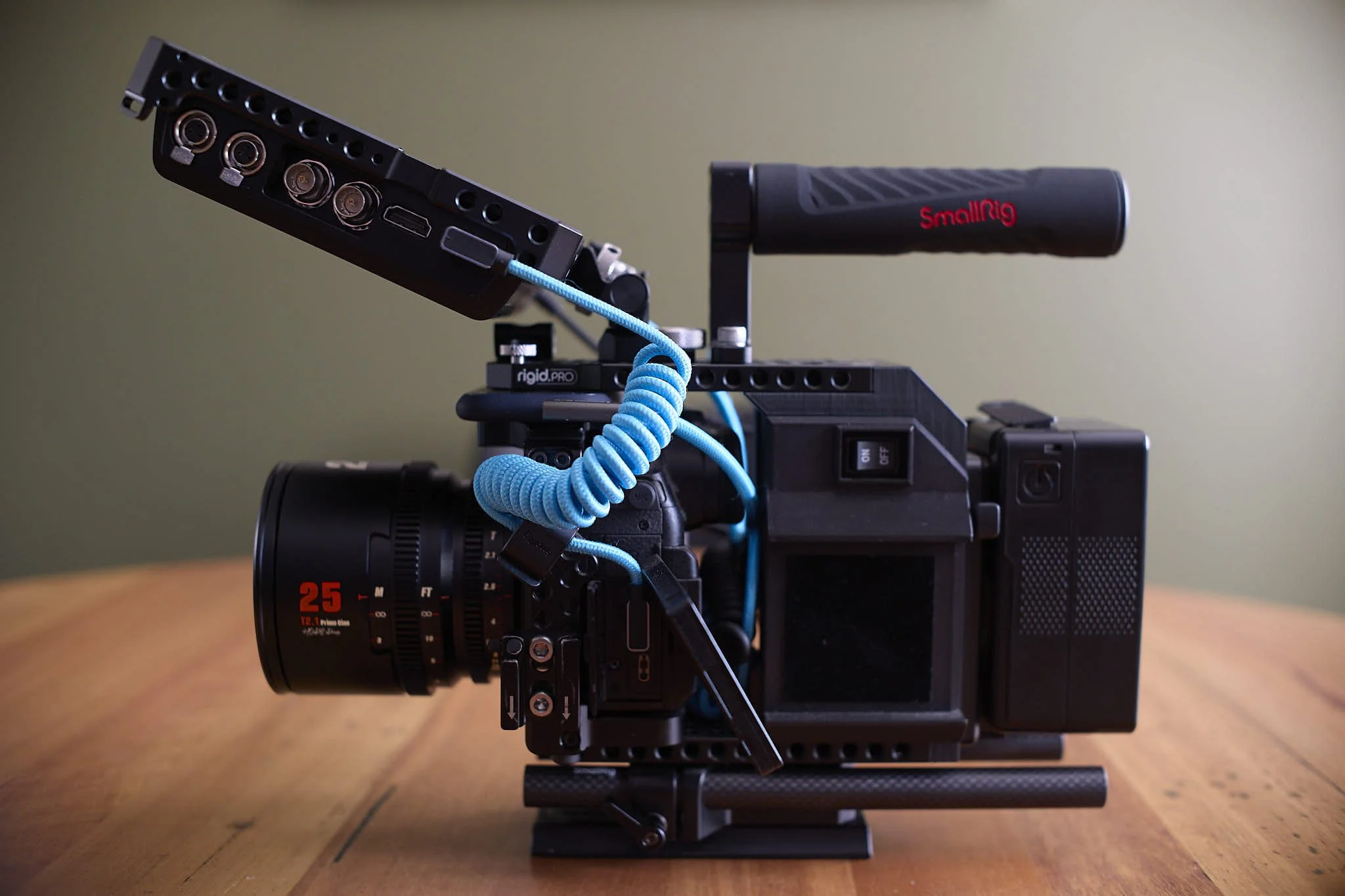
My choice has been to use Panasonic cameras fed out to Black Magic 12g video assists, which give me some of the benefits of the cameras (flexibility, stabilising, AF, image quality, EVF) and some down sides (bulk, cabling, rigging generally, some processing limitations).

It looks the goods and after a settling process, it actually is, a lighter option looses some capabilities.

One down side above the ones I knew about before I went in was right there in front of me, but thanks to my lack of full understanding of how it all worked, I missed it.

When recording from my Panasonic cameras, the GH5s, S5, G9II, there are limited RAW output size choices, meaning that for relatively low output deliverables, like 1080/.Mov/25p, I have to shoot 4-6k B-Raw in granted, a choice of quality settings, but always 4k at least.

I have had several 700Gb jobs so far using multiple cameras for an hour or more.

Even at 8:1 or Q5, this can come in at hundreds of GB for relatively small jobs, just for that low quality output (often only single digit GB output files). I can deal, because with many projects, the capture quality is for me alone, something I can create a smaller master from and dump the original, but this strains everything on the processing pathway.

Even some simple test footage turns into a dozen GB.

If I had a BM camera, I would have the option of 1080/B-Raw native, but to what ends as I will still likely shoot multiple cameras, so multiple BMPCC4k’s?

I can handle the big capture files now, I just need a good down sizing work flow.

There is also the option of shooting ProResHQ/422 in 1080 to an SSD (G9II) or the BMVA (even a 3G model), but when compared, the quality takes a small hit even at higher comparable storage rates.

Serviceable 4k/12bit/B-Raw/12:1 is 34 MB/s, while 1080/10bit/ProRes/422/HQ is 28 MB/s, so less colour and bit depth and much lower resolution for almost the same storage.

This is a problem that is not really a problem I guess as I have become a “shoot 4k and crop/stabilise/Ken Burns the frame for 1080 output” convert, but coming from a stills background where I can do a two week trip on 32 GB, it is sobering.

A Closer Look At Some Premium Primes Part 3

The portrait lenses now. These are not a perfect match, the Oly being a 90mm equivalent, but I chose to leave the tripod where it was as I am comparing the specific lenses head to head, not their effective magnifications.

Colours are consistent again. Not sure I love the G9II with these lenses, but that is the camera (settings), not the glass.

The difference in the effective focal lengths is evident, the depth of field still stronger in effect on the shorter full frame, but once again, I am responding positively to the less dramatic drop off of the MFT lens, its ability to invisibly transition and a less flat look.

I guess what I am discovering personally is, f1.8 on a full frame lens has its uses, but at some time in the past, I just grew tired of the look and if I do want that look, I probably want it even more powerfully, like a 150 at f2.8 maximising compression and shallow depth.

This one is interesting. At the same aperture, I assumed there would be a massive difference as before, but the 45mm still has enough of the good stuff, plenty of gorgeous blurring, again with that harmonious transition.

Photography means a lot of different things to different people.

Tests like this help us understand not only a pair of similar but different lens trios in a (semi) controlled space, but also shines a light on our own likes and awarenesses.

My tolerance for gimmicks, forced looks based on exaggerated lens perspective, compression or shallow depth of field is waning, it probably came to a head some time around 2000 to be honest. My need these days is for the process to become invisible, for it to be a supporting of the way I see life, not the excuse to take the image, or the sole creative driver.

I would once take images driven purely by the excitement of learning new gear and techniques, but now I just need it to be my eyes and my memory without an obvious opinion added. I will admit video is for me more in that past space, which may explain why I keep going with it.

I have three excellent full frame primes that do several jobs more than well enough, but their main trick, using their format and maximum lens aperture are rarely appealing.

They are problem solvers, they can remove ugly backgrounds, shoot in the scarcest of light, separate a nearly impossible to separate subject from it’s surrounds. Sometimes they are even exemplars of their craft.

The Olympus lenses like most lenses in the MFT format, are more than that. They are always useable without panicky mental DOF math, always harmonious with my way of seeing and photographing the world (and the same with video capture?), but also fully capable of providing depth control.

I find myself less impressed with super fast aperture lenses these days, unless they have the benefit of the MFT or APS-c format and I find myself suspicious of the compromises made to achieve them. In video in particular, I find f4 on a full frame (2.8 APS-c/Super 35 or f2 MFT) is about perfect, but I will give it to the Olympus designers, these super fast primes are more than “just” fast glass.

MFT to me is not a choice driven by size or price as much as a preference for it’s way of seeing. It throws few moments of technical fear in my face while I work and just gets the job done without tell tale signs of the process.

For fun I did a couple of closeups below, the Magenta adjusted Oly file on the left.

A Closer Look At Some Premium Standard Primes Part 2

Now the 50mm equivalents. I am aware also that the 25 Oly when compared to their f1.8 version was a little tighter (the slower lens was assumed to be slightly wider, roughly a 45mm equiv).

For this shot I puled the tripod back a little, then spread the items out a little more.

Colours seem to be consistent enough, warm green on the Oly/Pana and cooler magenta on the all Pana combo.

Similar story to the wider lenses, although I feel the 25 Oly is actually tighter, so maybe the earlier comparison I read was wrong, maybe the premium lens is tighter than 25?

Again, there is an obvious difference in DOF drop off, but the Oly provides what I would call a working Bokeh look, the Pana is more of a Bokeh gimmick, like the Sigma 30mm I have. That ability to “cut out” a subject from a scene in the modern sense, but at the expense of context and a harmonious transition. Distances would make a difference here of course, getting closer to the statues would give both a stronger effect.

Now comparing them both at f1.8.

Chalk and cheese again, but no reason to compare them this way I guess, it does the format differences no favours at all.

Interestingly the 25mm at f1.8, even with the camera to subject difference greater than the subject to background distance can still blur the lights and wall enough to focus the viewers awareness to what is important, it just does it less heavy handedly.

A Closer Look At Some Premium Semi Wide Primes Part 1

Moving away from video for a while, time to check out these Oly super primes.

This is a test that fundamentally compares the best of MFT with three mid-level, full frame equivalents, something that has some benefit I suppose, as many may be torn in this space.

The Olympus lenses are the best of the best, the Olympus equivalent of Panasonic Leica and from what I have read in multiple reviews, they are technically better and built to purpose, the P/Leica lenses may or may not have the “secret sauce” in quantities that make up for the mild difference, you will need to make your own mind up there.

The S-Primes are solid, very god actually, but designed to be true hybrid lenses, which is nt an excuse, it is a called out design reality. They are consistently sized (quite big), extremely light, pleasant to use and handly, without feeling premium. Compared to the Oly glass they seem too big, too light and maybe a little expensive for their role (middle range, medium speed, B+ primes).

The true equivalent to the Oly primes are the Leica badged lenses, but their is not a set to compare and certainly not one I own. The monster 50 F1.4 Pana-Leica is cine lens size and price, not something I can justify at the moment.

I was reasonably consistent with these tests, the WB was matched. I used roughly matching Pana cams for fairest results (S5II, G9II), but an obvious colour difference is still obvious (I did not modify the Hue, just White Balance). The G9II is known to be cooler rendering than the warm S5II, the S5 would have been closer, but it is rigged up for video.

I have rarely used the G9II for stills, so deeper checking might reveal a setting I have forgotten.

First, the wide angles.

Both lenses wide open (the Oly at top, you can tell by the 4:3 image shape). The 17 Oly has slightly stretched the perspective, and produced a slightly taller frame (I matched edges, but did not move the tripod) and the depth of field is less shallow even though the aperture was set to a roughly matching 2 stops wider.

I am not going to test sharpness etc as these things are all on record, but both are obviously enough for professional use.

The Pana 35 provides that modern fast sharp/soft transition, but once you have drunk enough from that glass, is that always a good thing?

The “quality” of the Bokeh seems similar, but it is hard to compare fairly as depth is different.

There is enough clear cut away on the Oly lens, the Pana is probably too much for my needs. I personal reaction to the files is a positive reaction to the Oly depth, if I ignore the greenish tinge that would be fixed in post. The Pana file looks thinner to me, more delicate, but less grounded.

Comparing the lenses at the same apertures now, showing the real difference between the formats.

Both on f1.8, the Panasonic really steps ahead here in the shallow depth look, but that was expected. The Olympus could be easily used for an environmental portrait or group photo, but at the same aperture the Pana could not be trusted to provide enough depth, so I would probably go to f4 to feel safe.

Back Here Again, But A Little Differently.

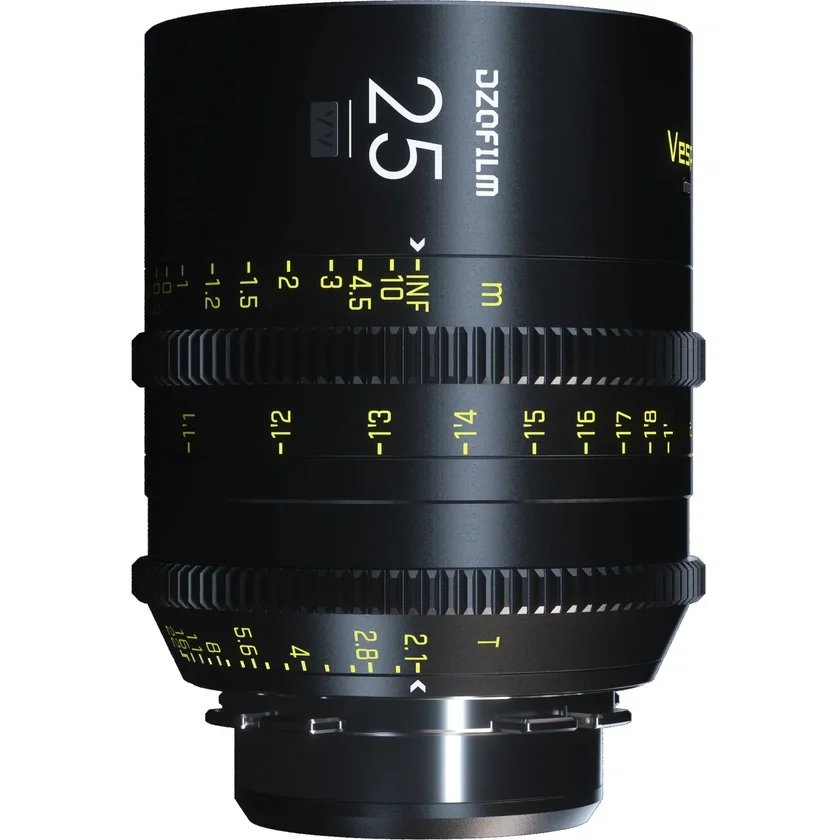
Based on a user comment in a review, that possibly their favourite DZO Vespid prime (first version) on their Super-35 RED camera, was the 25mm, a lens I had not considered before.

It struck me that it might be the perfect lens for my 4 format/1 lens kit idea*.

Bigger than most of the others, an impressive and impressing bit of kit. Could it be the one lens?

Lets look at the math;

  • On the S5 as a full frame it is a 25mm as marked, the widest I would be comfortable using regularly and ok even without stabilising.

  • With a little E-stabe applied it would come in at about a 30mm, a favourite focal length (the IRIX 30 was always a favourite, but if I count the crop for stabilising, it is actually not that anymore).

  • With high stabe (1.6x) or APS-c crop mode (1.5x), it becomes a near perfect 37-40, my perfect “one lens”. APS-c crop is one compromise of B-Raw recording in 4k/50, the S5 only does 5.9k/25 in full frame.

  • On the GH5s with no stabe it is a 45, also in the favourite range.

  • On the G9II, it runs from 50mm with no stabe to about 55-60mm with E-stabe applied. I am rarely interested in going longer than this and if I am, it is not in this type of shooting.

The last three also remove any failings of the furthest edges.

So, a useable wide to a short portrait lens, each focal length curiously aligning well with the camera it is mated to.

The other thing I like is there is room for a 40 or 50mm later (a full range of 40-100 or 50-110mm), or not as the whim and finances take me.

The lenses are generally considered to be poor-mans Cookes, gently soft wide open, then sharpen up to commercial level a stop or two in.

The Mk2’s are “better”, closer to a light weight Arles, but I am drawn to the middle ground the Mk1’s occupy (and the price).

I am currently hunting out more reviews. enough to know I am not compromising on this lens in some way (it is a wide angle after all), but this reviewer https://www.youtube.com/watch?v=iysvd1-86rM loved it most on the Red Komodo (about a 40mm equivalent S35 sensor).

Now, this is just one of the irons I have in the fire at the moment. Another is the BMPCC4k, mated with a more clinical lens like the Hope 25, for a 45mm with BM colours and rendering.

The Pocket 4k can also add the special something and other benefits, like 1080 B-Raw, full B-Raw control, no waste and lower costs (only needs a dummy battery), where the lens needs two EF or PL adapters, from $300 to $800 more.

Could I get as much of a boost to basic image quality from a camera that costs the same without other overheads, one that adds depth of options above that core benefit and one that empowers what I have instead of replacing it or do I need the “one lens” that lifts all my existing and future cameras?

Waste is on my mind as ever, the Spectrum primes in particular will suffer, but they cost me nothing, it’s the Hope primes that would hurt. Would it all be undone anyway if I need a multi cam setup, with only one lens of this quality, so I would compromise anyway?

Another iron is one of rationality. This one feels time pressured as the Mk1’s are being replaced by the Mk2’s, but if I ignore that, the reality of what I have now (several sets of cheaper lenses) hits home and to be honest, I have options**.

Example;

I shot a 2 cam set-up of a presentation recently in a crappy room, shotgun on camera (and LAV, except a user forgot to put theirs on, so I could not match all speakers), so a low visual and audio bar set, but I got decent enough results.

Camera 1 was the GH5s with the Hope 25 for the main shot, normal height, closer to the subject, the second cam was the S5 with a S-prime (35mm) shooting wide at a less nice angle and lower down.

This is not a fair comparison I know, but after two days of grading clips I noticed something interesting and I had by this time forgotten to care which camera was which.

The smaller sensor camera with the cheaper cine-prime just looked better. Simple as that, no tech to back it up, but it’s footage looked both sharper and smoother (with no filters added) and pleasantly warm. I found myself editing it less aggressively and that was from the “lesser” MFT camera.

Oddly and this is almost definitely an angle effected thing, the TV screen in both images (yep, that nightmare), was clearer and the edge fringing/flare around the subject was also cleaner. This is really speculative as the lighting was a horror story***, but it is what I took away from the project.

Ironically I was less bothered by the low light performance of the MFT camera (shot at T2.1) than the depth of field of the full frame combo (at f5.6).

Ok, the big problem and it is not a secret is “upgrade syndrome”, which is to say, yes I could have 4 formats from one lens, but with one lens, only one format at a time. Can I match this lens with my other options and I guess the question is, if I can match it, do I even need it?

My current 2 camera options are the 50 and 25 Hopes on MFT (45/100 or 90/50), the S-Prime 35/50/85 set or the Spectrum 35 and 50, although mixing these up makes more sense and the 24/50 anamorphics. A three camera set is even tougher, but from tha above, I can do three anamorphic, three cine or three stills lens sets.


*Full frame, APS-c, GH5s 1.8 and G9II 2x crop.

**Sirui anamorphic in two formats, 7Art full frame Spectrum (not so long ago considered ridiculously good for the money), MFT Hope and Vision primes (considered right now to be near perfect budget primes), my MFT stills glass (Oly in particular) and my S-series with a Sigma zoom as a bonus. Nothing premium here, but an awful lot of decent or best in class.

The anamorphics seem to be hitting a good place for me at the moment.

***A huge window/skylight directly above and behind the subjects with the morning sun drifting across it.

The Little Voice That Refuses To Go Away.

I am still jonesing for a serious video-cine lens, a single lens that can be adapted to any camera (PL mount), that is in the serious budget bracket and that has a know amount of “X” factor.

The mount is important because out out of one lens (a 35mm), I would have a standard wide (full frame), standard 50mm (Super 35 or APS-c), a long standard 63mm on the GH5s and 70mm on MFT. I could even throw it on a Sony like the ZVE-1, FX30 or a Canon of some type.

The lighting was poor on my part, but the 24mm anamorphic lens surely suited the task.

The DZO Vespid 1’s are the sentimental favourite, striking for many the perfect balance between professionally sharp and characterful. These seem to still stand out in the pack even when compared to more clinical lenses, even their own Vespid 2’s. The 35 is considered a slightly better lens than the 40 I was originally drawn to and a more sensible “one lens”.

The Nisi Athenas have never appealed for some reason, but in Australia their price is off putting. They sit above the Vespid 2’s here and I feel the V2’s are better all-rounders.

I have an IRIX 150 in L-mount, so a 30mm in PL would expand that palette cnsiderably (30/45/55/60), but they are like the Nisi, very clinical, very clean a little sterile. This works for the macro, but I am not as keen for video. They are also hard to track down, huge and the most expensive.

I want clean and sharp, but not at the cost of an organic, classic vibe.

The Vespid 2’s are probably the perfect balance of all factors. They compare to the Arles, are cheaper or the same as the Nisi.

The wild card, and I hate early reviews because they smack of the early marketing push, are the 7Art Infinte (not Infinite). These look to be comparable to the Nisi, maybe a little more organic (not as perfect-sterile), cheaper than all the rest and I can in some ways see a direct line between these and the Hope series by the same brand. I really like the Hopes, but they are APS-c limited and come in a single mount.

Having a sinlge lens that can fit multiple cameras makes sense, except that I cannt use these cameras at once, so it would add consistency of look to the process, but only at the lens level. The four formats would be shared over a minimum of three different cameras and these are all a little different to each other (even if I only use Panasonic).

Could it be that I could actually match different lenses to specific cameras and get a better level of consistency, while using up to three cameras at once? I have already matched the cool Spectrum 50 to the warm toned S5II, the cooler S5 getting the warmer Spectrum 35, with some success. InV-log I could actually match them up using the cameras fine WB controls.

I need to consider also (especially considering the last paragraph), lenses I have like the Spectrum 50, Hope 25 and 50, my three anamorphic Sirui (2 MFT, 1 L-mount), Panasonic S-primes (35/50/85) and several MFT lenses that are not rubbish by any means.

The reality is, the lenses are important, but they are nt as important as other factors. For example; Vulhandes made a great video about the Vespid 1’s https://www.youtube.com/watch?v=Ok2mzAT2xuc , but he makes great footage, so I could argue he could have made that with most lenses (and seeing as some shots have them all in frame, I guess he did use others).

Story Driven Thomas did this on the Sirui anamorphic https://www.youtube.com/watch?v=R8S4ioLDlLk which in many ways influenced me to buy them. Again, great art video, so lens or maker?

Mark Wiemels made an excellent video on the Infinte https://www.youtube.com/watch?v=nTwDUHEwm50 , and while technically competent, the video was made to be a sample video, not an art piece, so hard to compare.

There are a lot of contradictions at play here and the internet does not help. Do you want perfection in a lens and add effects after, are you after character in lens, need AF, use filtering, like legacy glass, are ok with anything because you will control the best bits in other ways (lighting etc)? Which, if any or even all of these apply to you?

The reality is, Roger Deakins wants the best, most clinical, spherical glass you can get, effects added later, while Zack Snyder used an antique Canon range finder 50 wide open at 0.95 on an 8k Monstro sensor. Neither is subjectively “right”, they both produced professional work.

Maybe I am putting too much stock in specific glass, caught up in the hype. maybe my secret sauce should come from somewhere else, like the little Pen half frame 25mm I seem to like? I have to recognise, my choices are often mood based, such is the softness of the topic.

For me, I want smooth sharp, not “hyper” sharp, like the 8k Sigma to Sony look. I want smooth footage, with invisible technical effects, a creative transparency that lens choice should not be the primary or even a major source of (something I know only really effects the initiated).

I will use mild filtering if I have to, but would love it if much of that smoothness came from the lens. Lenses that I feel do give me some of that now are the S-Primes, my Oly 12-40, the Hope and Spectrum lenses, m anamorphics and the add legacy lens.

Do I need more?

Basically what I am saying here is, there are so many factors at play, I may be over stating the importance of a lens as fulcrum of my process and under estimating the value of good technique.

Quick And Dirty Comparison

A friend James loaned me the Olympus holy trinity, the f1.2 17, 25 and 45 lenses. He is a relatively recent convert to MFT coming from Sony.

Our journeys are different, his a serious hobby, mine is purely making a living these days (evinced by me gifting him my A3+ fine art printer and 400 sheets of fine art paper, a hobbyists thing needing an enthusiastic passion, just more work for me).

He came from Canon to Sony via Fuji and some others, picking up a OM-1 very right and seeing the light. His collection of lenses is impressive.

My journey also started with Canon (MF, AF and digital), some Oly MF, then most early digital mirrorless (Fuji, Sony, MFT). I settled on Oly early days as it was basically the only workable system at the time, skinny as it was. I re-entered full frame with Panasonic mostly because of video, but it sees occasional use for stills.

I was reluctant to try them to be honest, because I know they are exceptional, format myth busting actually, but I cannot afford or justify them.

I loaned him my “fast” Sigma 30 f1.4, my low light champion, a lens I do not use much as I dislike its habit of flattening the subject with its in-fashion sharp-soft look. Not a fair trade, but it is what it is (we have most other MFT lenses in common).

At a quite short 30mm, this lens can look more compressed than my 75. This can be fine sometimes, but something I am becoming less keen on.

My obvious comparison point, and I will do a better job of this later, is with my trinity of S-Prime Panasonic lenses.

Now to be fair, the Oly lenses are weatherproof, considerably faster in most respects, all metal, have a very nice manual focus clutch, are as sharp as a vipers fang and surprisingly compact, but they are dearer than the S-Primes (I do feel the S-Primes are still a little over priced) and the format should balance out the depth of field difference at their maximum of f1.8.

The 45 wide open vs the 85 at same. Every effort was spared to be consistent….. obviously.

The Panasonic is on the right.

Takeways were;

  • The Pana made me back off a bit, maybe a full frame thing and the 85 does have a longer minimum focus distance. The whole thing feels clumsier to be honest.

  • The Oly was faster and more accurate to focus, but I will admit that the S5II is not set up for action like the EM1x. It is very much a matter of a specialist camera I am very familiar with compared to a less sure footed hybrid camera relatively new to me.

  • I prefer the colour and brightness of the Oly combo in three of the images, but that is also possibly camera based.

  • The Pana seems to hold better highlight detail in the bench shot, but again, no consistency of process (or processing), see below for more.

  • I think the head shot is a wash due to the different focus distance used, the Pana was closer and it shows.

  • The Oly lens seems to retain some three dimensionality, the Pana is flatter (can and statue shots). This is tough to measure as the lens is magnifying the subject by the same amount but is using a shorter focal length to do it. Not sure what that actually means.

  • Full frame at f1.8 seems shallower than f1.2 in MFT (for better or worse), even with a less impressive close focus distance and when I was fair to both.

  • The Bokeh quality, a priority of the Oly glass, seems to be just fine on the Panas.

  • The Oly lens and camera combo seemed to produce more consistent results, but they could be camera set up, the slight depth of field advantage and possibly better close up performance, the statue images being the most obvious.

  • The Pana combo looks biased towards yellow/blue, the Oly leans magenta/green.

After a bit of processing (the left image got more, mainly highlight recovery), the pair are hard to split for detail. Pana lens is on the right. The Pana seems to hold more high end detail, but on closer inspection it is a mixed result and the Pana file definitely looks flatter and less real.

It is sobering to remember the difference in formats.

Some Things About Lenses You May Not Know.

There are a lot of opinions around about lenses and many of them are based on the same opinions we have had for ages, perpetuated by the makers and some purchasers through ignorance or sometimes deliberately.

Lets look at some of these myths.

1) Fast (wide aperture) lenses are better than slower ones.

This is not automatically true, in fact in the past slower lenses were often considered more stable and reliable, faster ones had to go to extreme measures just to be as good, while delivering the special feature they were bought for.

Early Olympus and Leica for example made no distinction between their faster and slower primes, each lens was made to do a job up to the same standard, just different jobs.

Hollywood set-like lighting captured with the kit 40-150 Olympus. At f8, which was needed for the correct depth of field, no other 40-150 I own would have made the image any better.

If you need a fast lens, then get one, but don’t buy a big and expensive super fast prime lens to get your landscape passion off and running. Most lenses are near identical at smaller apertures and once you are over the uber-blur look, you may rarely use the very wide aperture that cost you so much.

Few professional photographers rely only on fast lenses and wide apertures and the look they produce, these images simply do not tell a story or add context.

Sports, wildlife, indoor and portrait shooters may lean towards them, but often out of need. Shallow depth is only one type of image and not so long ago it was considered to be a side effect of low light shooting. It is not a coincidence that fast and accurate AF and the fashion of very shallow depth imaging came hand in hand.

More important for you may be the rendering of a lens at a middle aperture for landscapes or environmental portraits, something a super fast lens may not be very good at. Look at the bulk of the work shot for National Geographic or similar documentary works, there is little shallow depth imagery and when there is, it is often driven by need.

An early image taken on the Sigma 30 f1.4, a lens known to produce super sharp images wide open and creamy Bokeh. Since purchasing it, I have rarely used it, possibly responding to the flat, very modern rendering or maybe the large (for MFT) form factor? The reality is, I like context in my images, something this lens is designed to blur away and because of that, it’s a bit of a one trick pony. I would hate to be forced to shoot with only this type of lens.

2) Bigger and more expensive lenses are inherently better than smaller, cheaper ones.

Any lens, if made to the needs of its design concept, does not need to be any bigger than it needs to be, which is to say, that monster chunk of glass up front, might not be an image improver, it may simply need to be there equalise the lens with it’s lesser stable mates.

Designers go to great lengths to make their flag ship designs their best lenses, something they may find challenging as lesser lenses pretty much come together effortlessly.

Large lenses also mean bigger filters and they require better flare controls (lens coatings and hoods).

The lens that took this (17 f1.8 Oly mk1) is not overly special on the test bench, nor impressive to look at. It has soft corners wide open (often a field curvature thing that flat charts cannot measure, which means nothing when used in the field), average overall measured sharpness (not visual sharpness, which is excellent), a very small front element and form factor, mediocre Bokeh by modern standard with a modest aperture, but it consistently takes some of my favourite images. The designers wanted a good street photography lens and made just that.

3) The lens mount does not matter (when do we even think about that?).

The lens mount determines the stress placed on the lenses design. The Sony mount for example is quite small, the sensor is actually bigger than the mount itself (hides the corners), meaning the effort made to make wide lenses for it has to be both clever and extreme resulting in some massive, complicated and heavy glass.

Nikon on the other hand have made their new Z-mount so big, they could almost accommodate a larger format sensor with it. This makes some aspects of lens design like super fast and fast-wide lenses significantly easier and they can over engineer a lens, knowing the extreme edges are not needed.

The larger mount also results in about one stop less perceived depth of field, so a modest f4 lens acts like an f2.8 visually.

4) Lots of glass makes for better lenses.

Again, like points one and two, more glass and glass with exotic lettering (LD, SLD, Asph etc) is not there to make a lens better, but more likely just to make a lens possible*. If you make a lens faster, longer, wider, or a zoom (possibly many or all of these), it gets harder to achieve good results so extreme designs with lots of special glass and lens coatings become necessary, even mandatory, resulting in that heavily corrected “perfect” look.

A common theory floating around is that lots of highly corrected glass tends to render a “flatter” 2D looking image, one that looks less realistic and satisfying to the eye unless you accept the paper cut-out sharp-soft look as normal. Whether that is true or not, there is a look some modern super lenses have that to be honest I am not a huge fan of (see the Sigma 30mm image above).

I am reminded of the three EF tilt/shift lenses Canon made. Two were not so hard to make (45 and 90) so they got no exotic glass and no red “L” ring. The more difficult 24mm needed extreme effort, so it got the works over two models. Perception was the L lens was better by default, which was erroneous as they were all basically identical, the others just suffered from Canons odd “L” class segregation policy (only lenses with exotic glass got the L designation).

Ironically, more glass increases the chance of lens miss-alignment, introducing flaws. This is less common these days, but as Lens Rentals revealed in their testing of multiple zooms, not completely solved.

5) Sharper is always better.

As any cinematographer will tell you, there are types of sharpness and sometimes down-sides to too much sharpness or contrast. There is more to a lens that it’s sharpness, in fact of late many reviewers tend to hand wave away sharpness as “we have plenty these days, even in kit lenses”.

The selection of a lens needs to match the needs of the job.

Sharpness is like vehicle speed performance, it needs to be viewed in balance with other elements like handling, comfort, brakes and economy. Is a straight line speed racer a better car than a road tourer?

I have personally come to class lenses as hard sharp, simple-smooth sharp, or micro-contrast sharp and have found that the type of sharpness is often connected to the out of focus rendering with my sharpest lenses not always rendering pleasant Bokeh**.

None is better than the other, but each does it’s intended job.

Super sharp corners wide open with perfect field flatness are basically a waste unless you shoot perfectly flat subjects wide open all the time and quite often, there are other factors that effect sharpness or it’s requirement.

Taken on a $100 plastic fantastic kit tele lens, this is not only sharp enough, but “perfectly” sharp to match the subject and look I was after. I have three 40-150 lenses used as the light requires, the biggest and heaviest being the fastest, but in this situation would it have taken a better image? I am often grateful that I had that lens on that hot day in Japan as it captured a dozen of my favourite images without unnecessary weight, bulk or aperture speed.

6) Test charts are needed to determine quality.

Lens tests are a basic form of categorising a lens in direct comparison to other lenses using the same test processes and the user needs to be aware of the process and it’s limitations.

No more, no less.

The lens test has always been a good place to seek justification for a purchase or feed the lust for a future one, but they must be taken in specific context to their process and the reader needs to be aware that there is a lot more to a lens than test data.

Examples of confusion I have witnessed are different cameras being used, sometimes in different formats then the results directly compared, or the top 20% of MTF charts compared, ignoring the reality that both lenses filled the first 80% effortlessly.

The real question is what does the image look like?

I was once told by a Leica technician that lens test procedures are important to some extent, but the only way to find out if a lens suits your needs is to use it for at least two years. The modern equivalent is to look at all the images taken with a lens in situations similar to your ideal.

Are the images it makes all same-ish, do they look flat or two dimensional, are they too boringly perfect, lacking life or character? That lens may test very well, but is that enough?

Designers always have a goal in mind, but more recently that goal seems to be to make the “perfect” test bench lens, no matter the cost in other areas.

The only way to really get to know a lens is to use it doing what you do, how you do it.

7) More Bokeh is better.

For a start that is a regular mis-use of the term.

Bokeh just is like the weather, it is not a measurement like rain fall. You can have different Bokeh, more or fewer out of focus elements in your image and the effect can be exaggerated or avoided as needed, but more blur is not fundamentally a measurement of better Bokeh.

This is an often very real reason for buying a super fast lens or two. The ability to loose a background to soft and beautiful blur is however only one photographic option and assumes that the subject in context to their environment is not wanted. This is rarely the case in the real world.

You can’t tell a story with a super shallow depth of field image, only a part of it. If you intend to tell stories, you will find that the lenses ability to render harmonious semi-soft backgrounds is more important than it’s silky soft blurring of everything.

Any image, unless taken of a flat surface will have an element of Bokeh because depth of field is a measurable thing, so when buying a lens, look at it’s rendering and how you react to it in all circumstances, not just up close-wide open.

Taken with the 17mm lens mentioned above, a lens that has such expanded and coherent Bokeh transition that I call it my “never miss” lens for street photography. I even have images that are misses, but the lens makes them acceptable. It can be shot at f2.8 with manual focus set to 5ft and is sharp-seeming from front to back of the image. I can even safely use it wide open with similar results in low light. This image that could be called “Arrows of confusion” is a good example of one that requires more depth to tell the whole story.

Lenses I have come to respect, even love over the years are a mix of those known to be spectacular and some very modest lenses. The right lens for the job is all you need***.

The Olympus 17mm f1.8, featured a couple of times above is one of my most used street and travel lenses over the last twelve or so years and more recently a video favourite. It became a favourite not because it was bought to be a hero lens, in fact I struggled to commit due to iffy reviews (but there was not much choice), but once I started using it, the doubts simply went away and it became a compulsion not a choice.

More than a few times it has surprised me, excelling in areas I had assumed it weak and it is fair to say, it taught me a little about lenses.

A staple of ten trips to Japan (possibly the only lens that has made every trip), it and the more impressive looking 75mm f1.8 are responsible for more than half of my favourite images.

They are an example of two very different lenses, one forgettable on paper, the other with a stellar reputation, complimenting each other perfectly.

I appreciate it’s more forgiving, elongated Bokeh rendering, not usually a modern Bokeh enthusiasts go-to, but ideal for street imaging, it’s resistance to flare and handling of strong light, it’s tiny form factor, super reliable AF, manual focus clutch (basic but workable), perceived micro-contrast sharpness and natural organic colour.

It has become an unlikely landscape favourite, a core street champion and I even like it’s shallow depth Bokeh-when I need it.

My 15mm Pana-Leica is similar in many ways, but seems to be better at dull day brilliance and snappier sharp-soft shallow depth images, so they can act as a the perfect pairing.

The technically stronger 15mm Pan-Leica is a nice foil to the 17mm justifying both in my kit, but if I had to choose, the 17mm would be it. I can speculate with some surety that the image above taken on the 17 would be slightly warmer-more organic looking, less delicate-sharp and the people in the background slightly more coherent and smoother with less of that foreground “snap”. Same-same but different.

If I owned the f1.2 version of the 17mm I would probably appreciate it for paid work when stresses not of my choosing come into play, but when stopping it down to f2.8 or 4 for street and general travel, it’s images would likely be no different.

I am not saying the 17 f1.2 is not a very special lens, but for my needs, it is overkill and provides nothing my more pedestrian Panasonic 15 or even the full frame 35 f1.8 cannot, which thanks to the full frame sensor has similar depth of field, better low light performance and lighter weight.

For my more recent trips, the 9mm Pana-Leica, basic 15, 17, 45 and kit 40-150 Oly with the kit 12-60 Panasonic lenses have been more than enough for my needs and in total weigh less than my Oly 40-150 f2.8 or Sigma 28-70 f2.8 while adding depth and options.

Very often an f4 version of a professional zoom matches a f2.8 one at shared apertures, but costing and weighing half as much. Which would you take on a long hike for landscapes?

Also cheap f1.8 primes are often excellent and very stable (and enough), low glass count lenses can have very good 3D rendering and low flare.

There is no shame in buying the lesser lens, sometimes it is even the smart move, so before getting blinded by the hype, look to actual users reviews, people who have been around the block a few times and ask yourself “what role will this lens fill in my kit”, before just buying the dearest and heaviest option.

A second opinion https://www.youtube.com/watch?v=yFAZOXxie4w

*There are many cases of lens spec creep over the years that have not bettered the optical quality of a lens, only retained quality after a feature is added and compensated for. An example is the Canon 100mm Macro lens. The very first FD lens was not AF, internal focussing, stabilised or overly fast at f4. By the time Canon had improved it over 3-4 models until the last EF 100 f2.8L IS, with internal focus, was produced it was not made appreciably sharper (macro senses tend to be near reference perfect by design). All the special glass and clever design had managed to make a faster, heavier, dearer and more complicated lens that was the visual equal of the much easier to design original from 30 years before.

**In my Olympus kit the 12-40, 75-300, 45, 75 and 40-150 f4 are smooth sharp with pleasant Bokeh. The 40-150 f2.8, 300 and 12-100 f4 are extremely hard-delicate sharp with often busy Bokeh, the 17 and 40-150 kit are micro-contrast sharp, Bokeh a mixed bag, but sometimes elongated or more coherent in transition style.

***Some past favourites include the 180 and 28 f2.8, 50 and 90 f2 macro OM Olympus, Canon FD 24 f2.8 SSC and 100 f4 SC, EF 135 f2L, 200 f2.8L, 400 f5.6L, 35 f2 and 50 f2.5 macro (old models), 28 and 85 f1.8 USM’s, Olympus 17, 45 and 75 f1.8’s, all three 40-150’s from the kit to the f2.8, 75-300 kit tele and 300 f4. A mix of premium and more ordinary lenses. My most commonly useful and impressive lenses have been macro’s but curiously I do not own one now.

My 5.11 CAMS Bag, No War Zone, Just A Quiet Life.

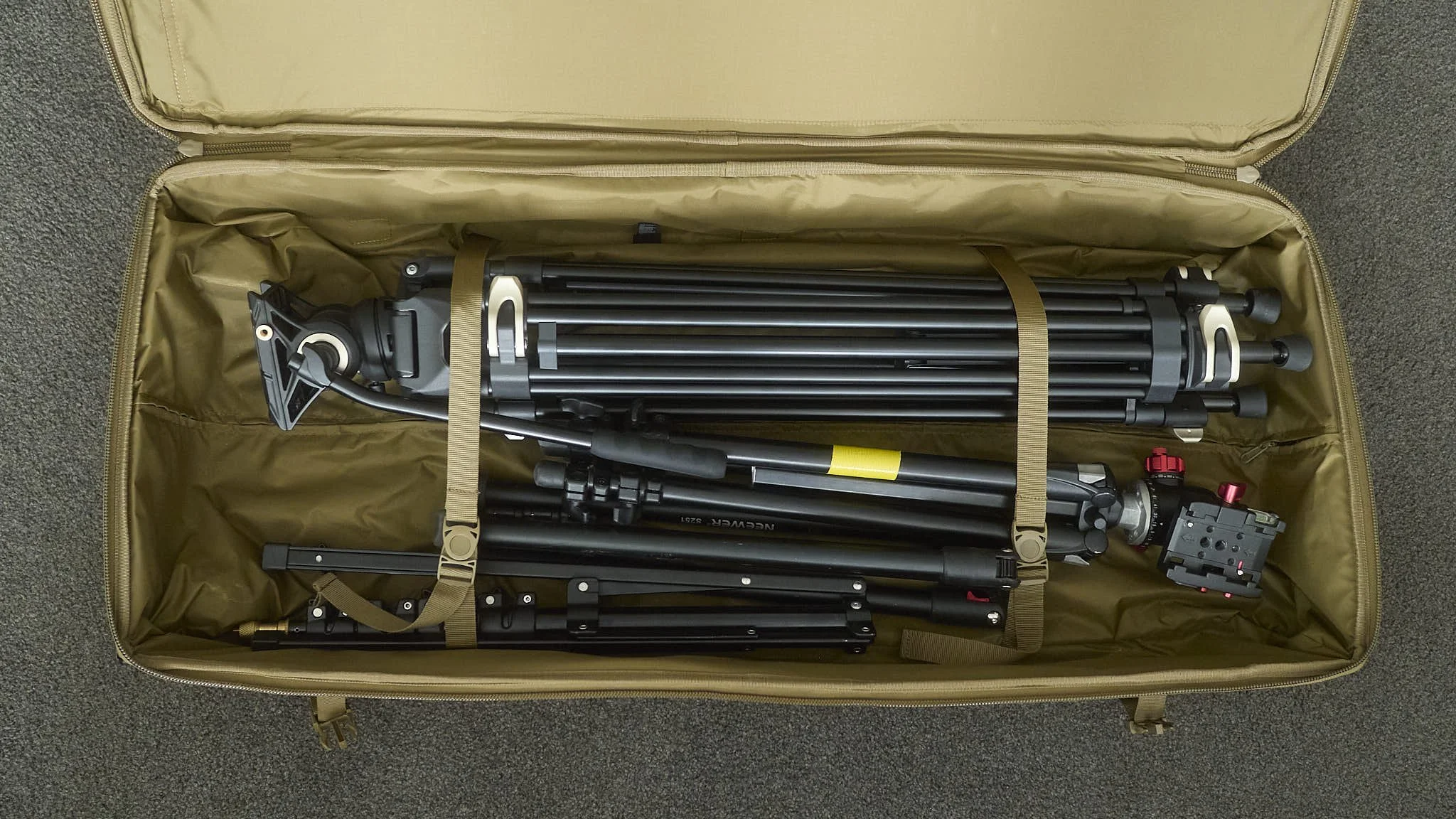
The 5.11 CAMS (Carry All My Stuff) bag is designed for tier 1 operators to haul their war fighting gear across the world. It is roomy, smartly designed and tough as nails.

Looking for a photo/video bag that can take stands, large tripods, a mountain of other gear, it was constantly the only bag I found that could fit the bill. It is really hard to find a one bag solution for 40” (1 mtr) long items, with both tall and long camera rigs, lots of extras from lighting, sound gear etc.

One bag, not a trolley of bags, not a backpack, two shoulder bags, a roller case and something in the hand combo or several trips to the car.

One bag……with wheels.

So, I have it now and what does it hold?

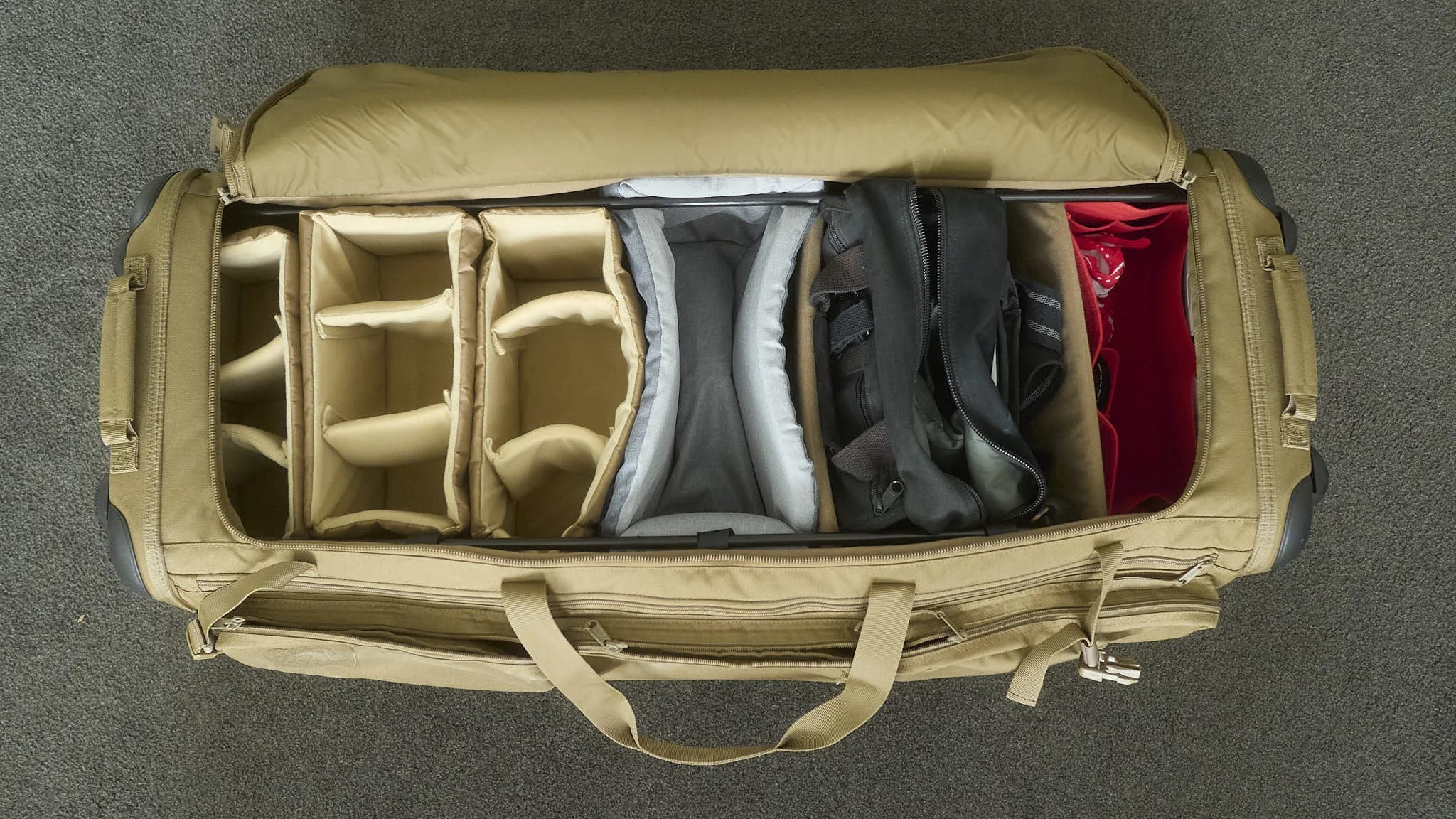
In the under compartment, which is the secret to it working at all, it holds the huge AD-01 tripod (the depth of the bag is only just enough at 5”), another tripod for the B-cam or to use with the tele-prompter we sometimes employ, 2 large and 2 small light stands.

That new Smallrig tripod is the longest I own, so perfect timing.

There is also room for some brollies, clamps etc. If I carry my big tripod separately (or strap it to the top), I can put 4 smaller tripods in there. I can even squeeze the foot for my C-Stand in.

The main compartment holds the equivalent of 6 camera bags*, even the bags themselves.

The black one is a Domke F810 bag, enough for my usual day kit, the grey one is a dog car seat cradle….., perfect to protect my main video rig.

No kidding.

I put my 217 Domke roller next to it and looks like a lunch box (I could put three of them in it)!

I have added a few matching camera inserts, a multi pocket bag liner and a…… padded car seat dog cradle, which is ideal as a “big rig” video camera protector. There is still room for a camera bag with a full stills kit*.

It is so nice to be able to have at hand some lighting and sound options, rigged cameras and organised accessories.

Perfect?

There is one issue, but not an insurmountable one. When full, it can take 60+ kg’s of gear, but it becomes hard to handle at that point. I simply won’t load it up that much and the under compartment is hard to access when the bag is heavy-full. I have decided to carry cameras in a separate bag, using the 5.11 for everything else, as cameras/lenses/batteries are the killers.


*F810/F2/F3x Domke, Filson Field camera bag, the average Crumpler etc.

Video, I Think I Did It Wrong And Still May Be.

I have been reading sporadically, “The Little Book of Ikigai”. I read books like this, instruction books in a sporadic fashion, because I hate reading serious instruction books and self help books count in that class.

Welcome a a small window into the reality of being me.

On the back is a little blurb that sums up the contents, as far as I have read so far anyway.

Start small

Find your flow

Discover your passion

Look for joy in the little things

My stills journey did this quite organically.

Starting slow was a given. There were few places to gain knowledge quickly and when and where I lived it.

Most of the books I bought in this period (no internet yet-anywhere) were either purely inspiration or general “how to” books, with a few genuinely useful biographies or deeper technical dives, which when mixed with monthly mags built a slow but solid base for learning.

For example it took me years to “get” apertures, depth of field, the quality and qualities of various films and processes, decipher lens design and the best way to handle a camera.

Mentors were few and often all on the same path (weddings etc). I am not saying there were no mentors for me to draw from, there were some, but they were also on a pathway of learning and busy, obsessed by their own work.

Finding my flow and passion were also relatively easy, because I was inspired by the things around me, limited to those things only and my visual inspirations supported that. The weird juxtaposition that is a library of books hoarded on the classic American landscape and wildlife palette or National Geographic magazines and applying that to their Australian equivalents aside, I knew what I wanted to shoot without question, I just needed to work out how to do it.

Don’t want to loose my head.

Some context.

There were not many images around in those days in the 80’s to 90’s. Compared to now, a relative drop in the ocean and they were hard to capture well. Getting the shot was often the win, a better shot the province of our betters.

Slow slide film, with the week long processing wait and cost, or black and white and darkroom processes (nobody serious shot in colour neg film) and thin information pathways, all contributed to glacial paced growth.

Professionals were the people who had their film paid for or were lucky enough to have a strong group to share with.

It is not a coincidence that the greats of the early 20th century American art movement often lived close to each other.

The joy in little things is I guess the library of wins I have filed away, the awareness of what makes a difference and knowledge I was doing them well enough.

Sometimes it is there to see, but only you can find it.

Video was a very different process.

Start small was a processes of acceleration from a stills knowledge base, a flood of incoming info from various online sources, learning how to get more and better results from gear I had or improving it and learning more (if I had decided not to bother, I may well have been happier).

From curiosity to the beginnings of a new skill set has been too fast I feel. The settled and solid knowledge of fewer but better and more reliable sources to draw from has eluded me. Too many opinions, some erroneous, many circuitous pathways, some genuine confusion, all resulting in time, money and sanity wasted.

The thing that comes home hard is the lasck of curation of opinion. The inability of noted authorities in the field struggling to use correct terminology for depth of field is vexing (”more of a depth of field” is not actually a thing guys) , but only the tip of the iceberg.

Find your flow is probably the key one.

I never really have and it is only recently, when suspecting I would be better off by reducing my expectations, processes, or focus, that I realised I was wearing too many hats, reacting to the ideas of others and forgetting myself completely in the process.

Video is a raft of skill sets from lighting to sound, cinematography, editing, writing, directing. Photography on it’s biggest day is half of that even if you print your work.

Discover your passion was the bit I completely rode rough-shod over.

My passion and my commercial needs have been mostly at odds, but I put commercial needs first, mostly I think to justify my investment. I occasionally get the chance to do something close to my ideal, but not often and when I do, the creative process is rarely in my control.

Is video maybe better as a hobby for me? My stills journey started as a hobby, that was how I learned by being passionate and obsessed, never counting the cost, just enjoying the ride.

Looking for joy in the small things. This is hard to do if you ignore the above.

It is the Ikigai ideal to take joy from all the small parts of the greater thing, elevating that thing from a mundane chore to a form of personal life-art, a study in coordinated perfection, but you do need to identify the what and why first.

I did early on, then I let the doing of it control me.

Is it possible to undo this, or even better to have avoided it in the first place?

Doing things the old way is pointless, those days are gone, but lessons can be learned. There are many more pathways to knowledge, especially in this world, but greater restraint needs to be applied. I need to be more discerning and patient.

I am intending to pull back, to try to find my feet and regain control of this mess.

A couple of take ways from this retrospective of my journey are;

Don’t be a slave to the physical camera, codec, rigging and ergonomics of the process. I tend to make rigs around my Video Assists, but prefer to shoot at eye level, so two incompatible processes battling each other. I do not for example have to frame and focus using a screen, I can use the eye viewer and simply record to the BMVA.

Less is more when chasing information. I can spend a wasted day trawling the internet jumping from one video to another, often contradicting each other. Find valuable, consistent and professional sources that align with my world view and don’t get distracted.

Do more, read less. This is the most valuable lesson from my past. The internet is best at finding the answers to the questions you need answered, at it’s worst answering questions you did not even know you needed to know, or why. Watching videos does not get any work done.

Do not spend a penny more. I have more than enough gear to produce a decent Indie flick, commercial work or personal project, I just need to use it better.

If it does not fit in my life or work, cut it loose. Do what you do well, avoid time wasting traps. I need to be aware of my role in all this. I am a decent cinematographer, have a working understanding of lighting and sound. I am not a wizz at editing and have limited interest there. I will make a three camera capture make sense, colour grade, clean up nasties, but I will leave clever transitions and special effects to the experts. These people are often not “front end” interested, so each to their own.

A good start?

I hope so.


Stocktake Time (aka Finding Reasons Not To Buy Another Camera)

There is always a little push to add gear, even when you are a hobbyist, but at the moment, I feel the options have gone next gen and I am using older gear on the whole.

This is I know an illusion, something I can easily coach someone else out of thinking, but can I do for myself and should I?

Looking at my kit critically, camera by camera, role by needed role, looking for holes, looking for possible overkill, looking for an excuse?

The EM1x (x3) is my main sports camera. The lenses that support it include (FF eq) 16~600 at f2.8 or f4 in zooms or primes and a range of 18~150 in fast primes, all “A” grade optics. The cameras are as fast as I need, faster than me basically and always a surprise. I am at one with them, something that cannot be under estimated.

Empowering a $100 lens to great heights, these are as good as I need. They are capable of empowering even my most basic lenses, so they actually expand my options.

The only thing I could want from them is slightly better low light performance, but considering my MFT lenses and their benefits, it would have to be found in another MFT camera, something I am not sure is worth the cost and I may already have it anyway (see below).

MFT as I have it handles noise well enough up to 6400 and a little noise is always ok for a gritty sports image, but dynamic range and colour suffers at ISO 6400 and gets worse above that. I can produce a usable image from a 12,800 file, but avoid it if I can.

Hand held 600mm at f4, 1/750th and ISO 6400 at my favourite dingy aquatic centre, something I am fully used to, but can I go better?.

Fixes possible are to shoot with a slower shutter speed accepting some lost files, or to use shorter, faster lenses (the MFT advantage), making sure to over expose and pull back, not underexpose and try to lift (it is always better to over expose ISO 12,800 than underexpose 6400).

There is no denying that full frame in exactly the same situation (magnification, aperture, ISO etc) does offer better quality at the cost of shallower depth of field. I just cannot justify a full frame 500 f4 or 300 f2.8, slower lenses mostly squander the format advantage and the available cross-over points are few (35-85 f1.8, 28-70 f2.8 and if I bought one, 70-200 f2.8).

Improving on these might be the G9II I already have, maybe an OM-1, but not “little white” the 50-200 which would add little in real terms. A 135 f1.8 or 150 f2 would be nice though :).

The G9II may be that camera, but to be honest I have never tried it.

It fills a lot of roles. It is my best video camera out of the box, meaning as is, or with only an SSD added, it is the most capable in almost every way except very poor light (it gets complicated).

It offers All-i, ProRes/HQ/V-Log without anything other than the SSD, or B-Raw with a BMVA 12g. It has the best stabiliser, the best video AF, most frame rate options, then it is also my highest res stills camera and it likely matches the EM1x’s in stills AF with possibly better high ISO performance (in colour and dynamic range).

I think some tests are in order.

In “full noise” video mode recording 4k or high speed 1080 V-Log in ProResHQ, but am I wasting it?

The only mild weakness is high ISO video (compared to the rest of my dual ISO video cams), video AF on some of the older MFT lenses and the big one is, I only have one. I feel that this is the stills upgrade I might need, but it is cemented into my video kit as the “movement” specialist. If I only had one camera for everything I do, I feel this would have to be it.

All my video options work with either standard SD cards or to SSD’s direct to or via a Video Assist 12g. This was deliberate and has saved me effectively a camera body or both my BMVA recorders in card costs alone. B-Raw is my end point, cameras that offer internal ProRes Raw with expensive card and high storage needs are of no interest.

The S5II is currently my “super hybrid”, the S5II gets a lot of filler work in both my video and stills kits and is my best out of camera V-Log option. It lacks SSD or RAW-out without the paid firmware update, but I keep resisting that as I have other many options.

For stills it is the low light fix, but is limited to a 20~85mm range, something that does not bother me overly. The Sigma 70-200 f2.8 is often floating around in the background as a sports option, but my main indoor sport is Basketball, something the 85mm or MFT 75 f1.8 are more than enough for.

I struggle with the size of full frame for my day kit, only justifying it if the video or low light stills are very real possibilities.

At this point in my stocktake, the G9II in this role probably makes more sense, but then the S5II then becomes the odd one out.

The S5 is one of two dedicated video cams. With RAW-out, a slightly less digitally sharp rendering than the S5II and decent enough stabe and AF if needed, I like it with the BMVA 5” as my hand held or B-cam.

It could be used as a fully capable stills cam, but I like it more in video.

An ungainly looking rig, it works well for run-n-gun held held or static work.

In this role, I see little reason to replace it, in fact with Panasonic sharpening up their recent video options, I might even buy one of these in this role now in preference or the BS1H, or maybe skip full frame all together with a BGH1.

My GH5s was bought specifically to be the MFT video champion, mainly as a cheaper way to get full frame-like dual ISO performance. It lacks internal stabilising and AF is “old school” like the S5 and G9’s, but it was bought to be a solid, no frills video specialist, a static A-cam, nothing more or less.

As the core of this rig, anything more like the G9II or S5II would probably be wasted.

I bought it over the BMPCC4k at the time because it was actually cheaper (rare), I already had the BMVA 7” and if needed it could be pressed into service as a stills cam, something the P4k cannot do.

I would not replace it as it is in a role it was designed for and does it perfectly well. B-Raw is my maximum video quality end goal, 4k/50 my maximum in that space, so the lure of ProRes Raw is of no interest (V-Log is enough for most projects, ProRes is an option, B-Raw is better again).

The EM1.2 (x2), the long lens half of my day kit (with a G9) are old, beaten up, occasionally “twitchy”, but reliable enough for most jobs. The AF is plenty for sports with better lenses, the low light decent enough, they are solid without being exceptional these days, but solid gets most jobs done.

To be honest I do not really treat them any differently to the EM1x’s when I am working, but I find them slightly “laggy” compared to the X’s from off to ready to shoot, but they are still faster than most Panasonics.

If these were my high water mark, I would be ok. The demise of one will likely mean regularly using a spare EM1x as a day cam, but both would mean chasing up another new gen stills cam like an OM1 or second G9II.

The G9 (x2) is the wide angle day cam in partnership with above. These are maybe slightly better than the EM1.2’s in many ways, closer the the EM1x in low light, handling and general feel, but the DFD focussing makes for an odd experience with sports (no Pana long lenses), and video AF is slightly unreliable.

Video is lovely, if limited to non-Log profiles (I like Standard), although I have not looked closely into their HDMI output to the BMVA 12g (which they do). Maybe HLG or Cine-D in ProRes would be worth a look?

The only thing that could be improved here would be hybrid video, and video/sports AF, i.e. a G9II. I will not replace a worn out one with the same, but I will miss them.

EM10.2 (x2) the “shutter savers” are my usual third cameras, because it is easier and faster to change a camera than a lens and these are sure footed enough to use as short telephoto snipers.

I usually have one in my bag with a lens I might need, like the 9mm or a 45mm. Both have twitchy rear screens, so I usually use them to the eye, normal for longer lenses.

When used up, they will go and I doubt I will go this way again, but who knows. They are useful, have good enough image quality to mix it with the others and run for ages per battery.

*

So, improvements in video are really not needed.

I do not lust after codecs I have no intention of supporting or storing (4k B-Raw at 5:1 already eats up massive amounts of storage), I have state of the art AF, stabilising and several endurance options as good as I would need (in multiple options) and basically as good as I can get. Maybe another BMVA 5” would be added as a backup and to upgrade the G9II, but then I loose it’s small size portability, so more likely a cheap BMPCC4k, freeing up the G9II for stills.

An S1mkII or GH7 bring unwanted internal ProRes Raw, have expensive card needs, give me nothing above what I need and the S1 adds possible over heating issues. The G9II matches the AF and stabe and if V-Log is enough the S5II comes close enough as well. If I feed out to a BMVA 12g, what have I really gained?

In stills, the only thing that worries me slightly is low light sport, but I may have the answer already (G9II) and nobody is complaining. I can usually use the 75 f1.8 or shorter for basketball and netball, the f2.8 zoom when needed and even occasionally an f4 lens in some venues. I fear nothing really up to ISO 6400, f2.8, 1/500th, plenty for most venues.

Full frame for very low light is tempting, the Sigma 70-200 f2.8 the best option there ($1800au), but again 24mp and the super sharp 85mm S-prime does most of what I need and I get maybe two jobs a year where it matters (most top end sports have good light, the low end ones don’t expect miracles).

The ultimate would be the S1.2 with the 100-500 (Pana) and 70-200 (Sig), but I am not getting the work to warrant it.

Shopping list options;

A second G9II for stills ($2000au+). This would give me possibly a stop better low light sports performance, the extra pixels would also allow for the f2.8 zoom to be used more and cropped.

Firmware upgrading the S5II for video ($250au). The G9II then becomes the possible hybrid option (see above) adding power to my sports kit and the S5II becomes the movement cam (which it basically could do now in V-log). The G9II is no smaller than the S5II, but the much smaller lenses are shared with the stills kit.

Adding a 70-200 Sigma to the FF kit ($2000au+). Tis gives me reach when needed for tough indoor sports, elevating my kit to match some top end shooters.

So, the answer to the question “do I need to upgrade” comes back with a soft, “when I can, if I need”, no rush.

Odd Companions Or Fated Friends?

I have a lot of gear, some top tier, some “kit” meaning cheap, lightly made, with the assumption of sub par optics and junky handling.
I tend to pack for the job. I may take relatively basic gear, an older camera, maybe even an unreliable ones to a low stress job where multiple cameras are ok or a less impressive lens needed. A time when contingencies can be applied in the field if needed (an MFT advantage is more choices).

Nothing wasted, nothing under or over estimated. Everything used.

Actually looks pretty neat, just don’t use it in the rain!

Sometimes, a combination surprises.

I had a job held outside on a sunny day, no high speed sports, no lighting nightmares. The camera I chose was the EM1x, a choice I have been shifting towards lately because my EM1.2’s are ageing and are sometimes not as reactive when I need.

The AF is fine, but turning them on and off tends to add a short lag before shooting, some controls are stubborn. Time to give myself a break. No point in nursing better cameras (I have three) waiting for some time in the future. Use what you have when you need.

The lens was the compromise, the Olympus kit 40-150 f4~5.6. This lens is sharp, can be fast focussing if the camera is good, has very good bright light contrast, i.e. lower than some pro lenses (something it shares with the 75-300) and for most purposes the results are indistinguishable from dearer glass.

The extra depth of field of the relatively slow lens on MFT is not always an issue. Shallow depth is nice, but to be honest as a record keeper for school events I prefer to use more depth when possible. More depth equals more people sharp, wider interactions included and often, smoother roll-off to out of focus areas.

Basically depth of field becomes basically irrelevant or visibly so, not a tool, not a cool trick.

Gorgeous clarity, nice Bokeh, a gentleness that suits the scene. On close inspection, even with a 20mp camera, detail is retained down to individual hair level.

Another workable combo is the same camera with the 12-60 Panasonic kit. These two are my travel kit along with some light weight primes, used for low light and shallow depth of field.

An Odd Kind Of Balance, But Balance None The Less.

My video kit is a little odd when I look at it, but somehow it seems to work for me.

It’s a matter of balance, something that settles me in many ways.

If I look at it theoretically I have this capacity, in order of best to worst;

Best AF (if used and with select lenses)

  1. G9II (phase detect, MFT depth of field advantage)

  2. S5II (phase detect)

  3. S5/GH5s (late gen contrast detect, not trustworthy enough for some things)

The 2’s are pretty close but the more forgiving MFT depth of field and one or two lenses give it a slight edge, the 12-40 Oly interestingly seems to have a perfect balance of fast but smooth AF.

Best stabiliser

  1. G9II (latest gen, MFT smaller sensor advantage)

  2. S5II (latest gen)

  3. S5 (previous gen, excellent for static hand held)

  4. GH5s (rig weight and lens supplied)

Best processing range (colour depth, dynamic range, flexibility)

  1. S5 (BRAW)

  2. GH5s (BRAW)

  3. G9II (LOG in ProRes/HQ)/S5II (LOG)

The full frame cams have higher dynamic range naturally (14 stops), but the BRAW cams are more pleasant to grade. ProRes on the G9.2 bridges the gap somewhat to the S5II in basic LOG. I know that the S5II in BRAW is probably the very best image quality I could achieve and the G9II may also be a wasted resource, but if I upgrade either of them to BRAW, I loose their portability and in the case of the G9II, it’s excellent internal codecs.

Best low light performance.

  1. S5/S5II (full frame dual ISO)

  2. GH5s (dual ISO)

  3. G9II (expanded ISO)

The full frames again, but the lens options available to MFT do make a difference also. Some glass is only available to me or only as fast as it is relative to the focal length in MFT, but assuming F1.8 for both, then the Full Frames win (in some more compressed formats it is quite impressive).

The reality is, if I upgraded the S5II to BRAW capable, it would be my most powerful camera, but at the moment I have four options that all balance out in comparison.

The G9II is weakest in low light and grading range, as well as creating some monster files in Log/ProRes or LOG/PreResHQ, but has the best on paper specs (frame rates, and internal codecs) and it is the handiest, most reactive, steadiest and fastest. This is the cam I put in a sandwich bag to shoot on a small boat or in a stills bag just in case. Potentially it has the best in camera recording options, an advantage lost if I run it out to a RAW recorder, so I don’t, I just use the SSD out option. This is also possibly the most under appreciated stills cam I have, but that is another story.

My smallest rig, this one has the option of going onto a shoulder rig using AF and a wide angle (9mm), a tripod or a mechanical gimbal.

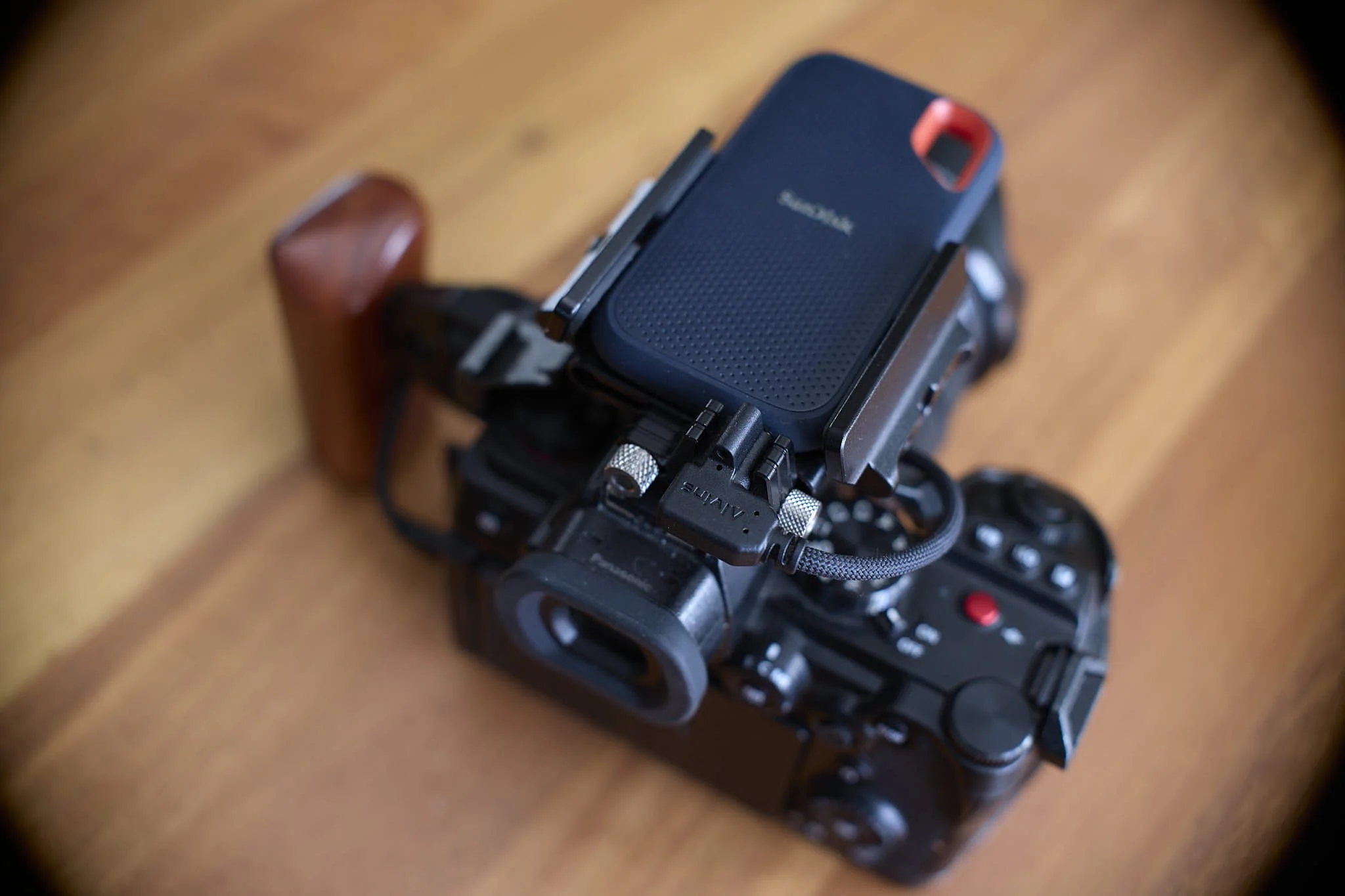
The SSD upgrades it to ProRes, so a small price to pay. If I had a GH7 with internal ProRes, I wuld likely still use an SSD as they are larger and cheaper than XF cards. The SSD holder is a Neewer, which I like more than most.

The GH5s is the camera that bridges MFT to full frame capabilities with good low light/dual ISO, the MFT lens advantage and excellent BRAW interface. Lacking stabilising, it is the “big rig” for static or careful hand held work, relying mostly on weight for hand held stability and that classic semi-steady look (although the 12-60 does add some real stabe). With the 7” BMVA, it is sound central and always the A-cam on sticks. Without BRAW, it only has V-LogL, but does have All-i codecs with a fast sensor and can even function as a decent low light MFT stills cam (something its closest competitor the BMPCC4k cannot).

The endurance rig, so the A-cam in interviews. Everything runs off the V-mount for a couple of hours at least.

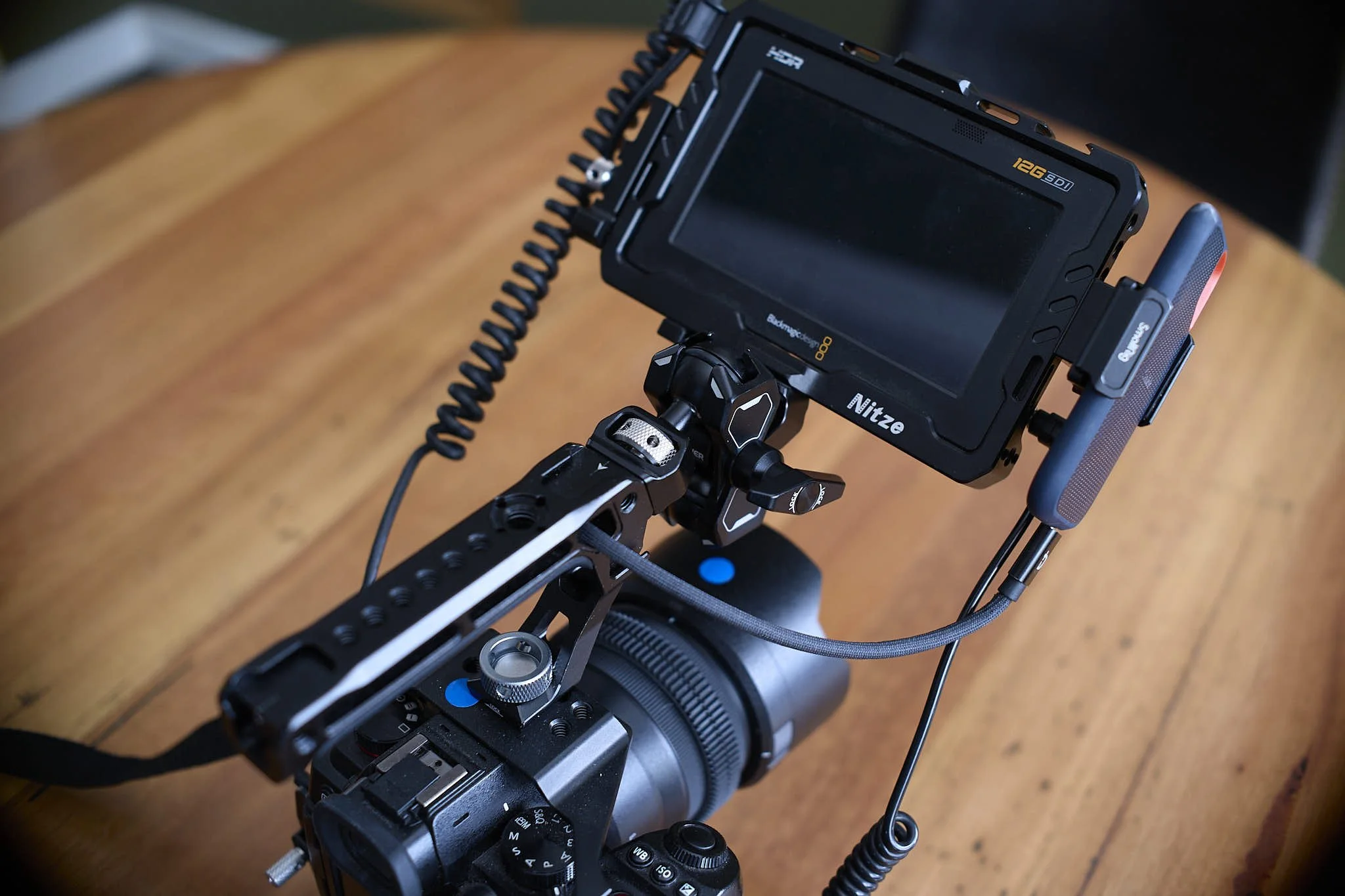
The RigidPro rig (the S5II/G9II model), neatly holds the SSD on top of the camera, all cables are connected at multiple points or go through the rig. Very clean and simple. The screen mount and handle are a new configuration, replacing a nato rail handle and flexi arm, which were messier and made the rig hard to pack. Balance is a little forward depending on lens, but not too bad.

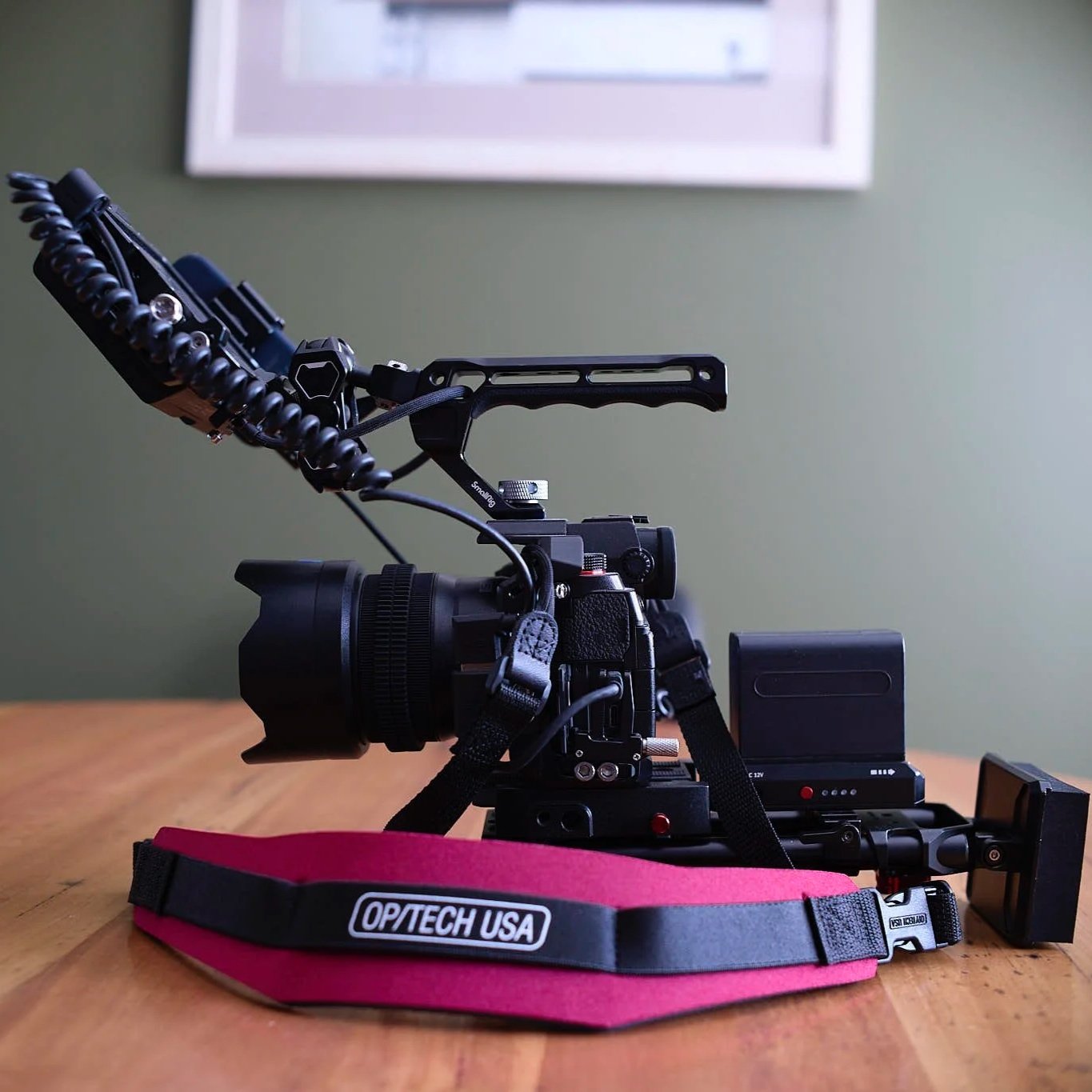
The S5 is the second endurance and BRAW camera (5” BMVA and V-Mount), giving me a decent stabilised and AF option, but I treat it more like the GH5s, using a heavy duty shoulder strap to aid stability and take some weight (works like a cine-sac without the bulk). The colours out of the GH5s and S5 are close, so I have my full range of lenses to pick from in an A-B pairing.

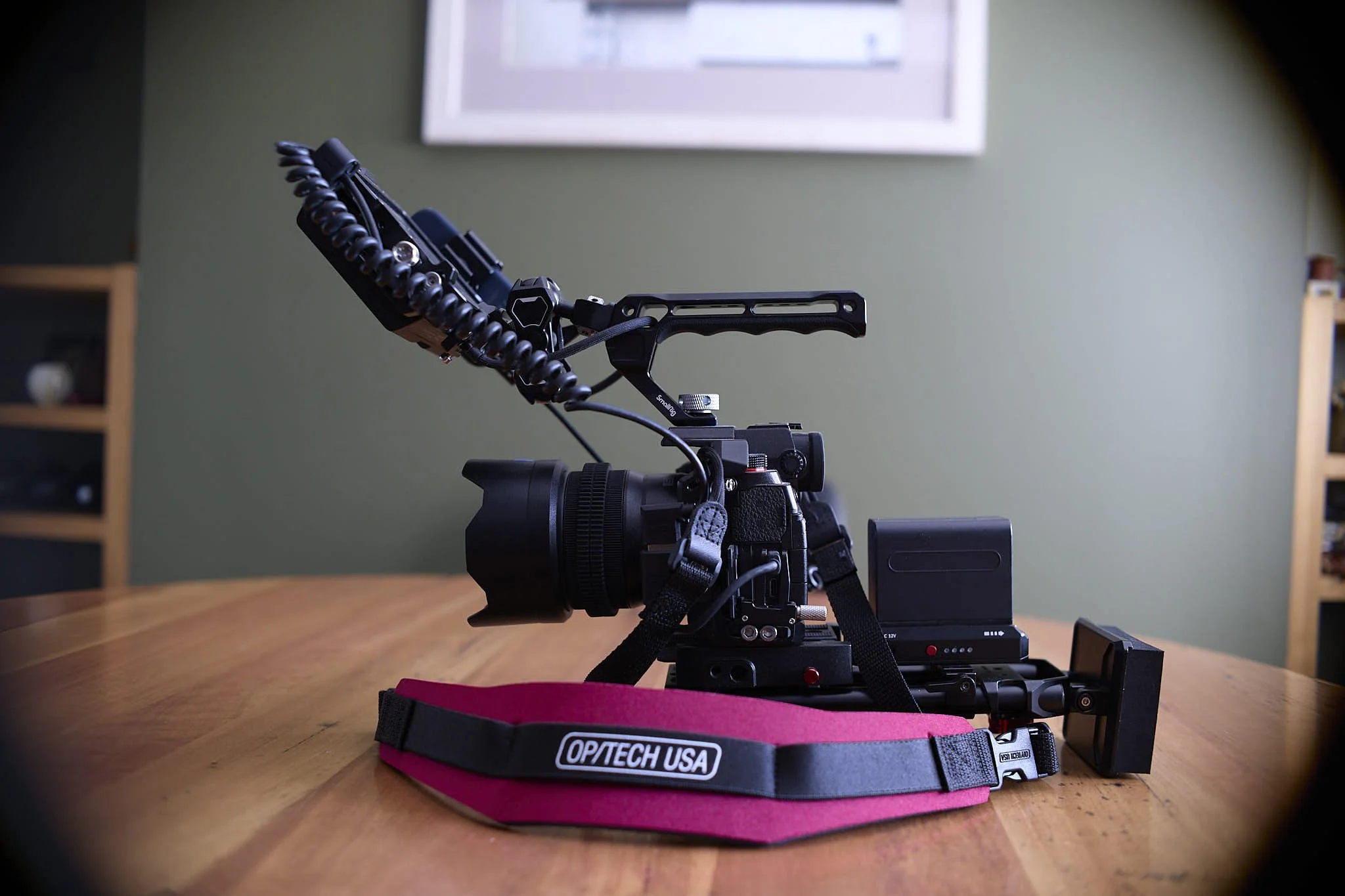
This one looks a little ungainly, but it is extremely well balanced, meant to be used from chest to hip height. The strap is my small and elegant solution to the cine-bag quandary.

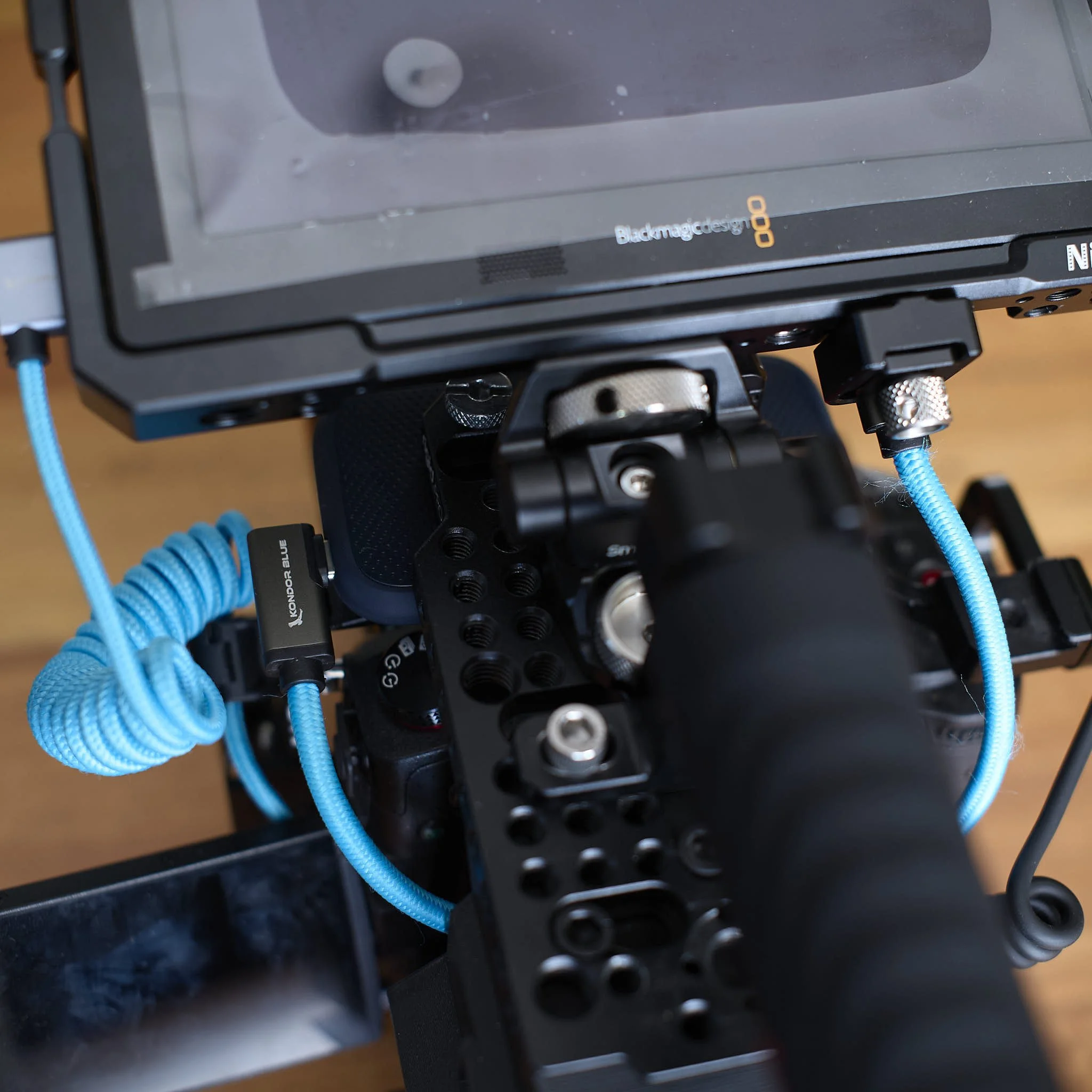
The cabling is a little less controlled, something I will work on, but it is a simple rig. The BMVA 12G 5” is run by a large NP on the rails, with two smaller ones on the unit itself. The camera uses a standard battery as it is rarely employed for long shoots and if it is, I either use a V-Mount mounted under the rails or use it as a B-cam, so battery changes can be handled during the shoot.

The S5II is potentially the strongest cam, but without the paid upgrade it is actually the weakest. G9II level AF and stabe are counter balanced by the needs of full frame (shallower depth of field, larger sensor to stabilise), the low light is equal to the S5II, in LOG it has the equal best dynamic range and all things considered, it mixes it well just as is, no RAW, no ProRes, just native LOG. The extra bulk of lenses is a consideration, but unlike the G9II, it does not need an SSD bolted on, so same-same really.

Balance.

All cams are capable of excellent results, they just get there differently. All are rigged to do their role as well as I need with static/endurance, semi mobile/endurance, mobile/static and purely mobile rigs. Any can do another role, but as is, they are each best suited.

I can hand hold the GH5s, I can use the G9II as a static B-cam or in low light with fast glass, the S5 as a run-n-gun or the S5II as any of these roles, but no one camera is the perfect answer to all roles.

For a light weight interview setup, the two S5’s in LOG work fine. For run and gun the G9II is king, the S5II the ideal hybrid and for maximum impression made, the GH5s in the RigidPro rig and cine lens looks the biz. I can run three anamorphic lenses at once and if needed trust two cams to their own devices in AF.

Could I make a single super camera or cameras? Sure. The S5II with 7” BMVA and RigidPro rig would be the “A” game, but then other cameras as well suited would be sidelined and their strengths, poorly applied, would not enough to balance things out.

The only option missing as I see it is the BMPCC4k, which would add a third BRAW camera, with no off board recorder needed and some more recording options, but do I need five cams?


Something Special?

A cheap little lens has intrigued me for a while.

The TTArtisans 35 f1.4, a $75au budget lens (in L-mount), designed for APS-C and MFT cameras came into my life a few years ago. It was one of those times I was looking for something a little out of the box, something different, for video mainly where I was keen to get away from the usual. I do lament the many wondrous lenses I let go over the years. I hope they are being used by other shooters.

Shooting stills with an S5 means cropping after the fact, because this is an APS-C lens, no doubt, but I have shot full frame video with it and “letter boxed” the crop like an anamorphic and cropped square for stills and the coverage is fine.

Even square there is a hint of vignette.

Sharpness is the expected mixed bag of decent to dreamy wide open central sharpness, razor sharp stopped down and the corners fall into the “character” camp.

At f2.8 it is as sharp as I would ever want for 4k video.

Sharp with smooth rendering. No processing applied.

Wide open, it is lovely, with obvious vignetting and slightly dreamy.

Not super sharp, but attractive, desirable even. Between wide open and 2.8 I have effectively two different renderings.

Wide open again at a longer distance, so maybe sharpness varies at different distances?

A nice 3d rendering.

My main application for this lens would be video, something it is far from ideal for mechanically, but the optics are worth it. A lens with a retro vibe shot full frame and cropped to suit. I have done this and it works.

The comic reality of this tiny little brick with a matt box in front on a full video rig aside, I am a little excited.

Train Dreams

I just deleted my Netflix account, but ended on an unexpected note of exceptional, emotional pain and bliss in equal measure.

I have never been so strongly effected by a movie or series.

It finished and I started to uncontrollably sob. I do shed the odd tear, usually to animal or feel good stories, but this let something out I feel may have been hiding for a long time.

Nothing to do with it, just a favourite place.

Life is, simple as that and Train Dreams celebrated that in every way possible.

Loss, love, time, hope, dept, connection.

I hope they get a lot of recognition for bringing this beautiful and shattering story to life, but a part of me feels the makers have already had their reward.

The takeaway for me, not that it matters I guess, is how lives lived often go undocumented and may seem pointless in the eyes of all except those who live or share them.

I wished that for Robert, a fictional character, but so very real as a representative of many like him, that there would be a record made of who he was, what he did and who loved him (which of course I was watching), but with the deepest sadness I realised that Robert, was representing the bulk of us, the incredible sea of lives lived and so soon forgotten.

Even if a record is made, like a photograph (like the one sadly lost in the fire), or a written record, that time would be the final arbiter of its importance.

Anything any one does for their own immortality is pointless in the long run, the only thing that matters is the effect we have on people here and now. If life is ultimately pointless, then the only thing that matters is how we live it. Anything we do to impress or subjugate others is also ultimately an untruth to ourselves.

Even mountains die, as do suns and even gods. The only part of history that matters is the bit you are living in now.

Watch it or not, I am just happy that I have, against my better judgement to be honest, to know it exists like the remains of our natural world are out there, whether we see them or not.

No more words.

How Much Quality Is Needed?

There is a revolution happening and it is moving fast.

Once, not that long ago, to make quality content, you needed a camera and lenses that most could not afford. People became cinematographers by going to school to access these cameras and the people who know how to use them.

You can now walk into a camera shop and spend under 10k and have enough gear to create a scene from many top tier movies. People and other resources are needed to copy anything that is thrown at you and of course the reality of CGI or AI is often an element, but at the core, the base line of it all, a good camera and lens, so good in fact you may need to reduce its inherent hard-sharp quality, are available to all of us who want them.

The Creator for example was filmed using a Sony FX3 with an antique Kowa anamorphic lens out to an Atomos recorder. This entire kit, in multiple, fit into a single plastic box. As Oren Soffer said in an interview (roughly) “If the camera gives us that basic quality we need, then done, move on, many other factors will matter more” and “All that matters is you have the right tool for the right job”.

Using that as a base line means any of the new range of hybrid cameras can record internally or externally the codecs and quality needed. Examples are the Nikon ZR with Red RAW, the S1II Panasonics with ProRes Raw internal and ARRI colour, or anything going out to an Atomos Ninja or Black Magic recorder like the FX Sonys.

What do you really need for top end quality?

Codec.

The minimum you should use would be LOG, almost universally available in a modern hybrid camera. It will open up the full dynamic range of the camera and is usually well supported by third party and software makers. You can get away with a lesser codec like Cine-V or HLG, but dynamic range or support is usually reduced in favour of out of camera ease, a poor trade.

DR is important, probably not as important as good lighting and exposure, but if a camera offers it, you may as well access it. Great work can be made with less than 12 stops of DR, but if you have access to 14+, then take it.

Minimum; LOG, preferably RAW

If your camera can feed RAW data out over an HDMI (or in some recent releases even intenally), then you should look at an off board recorder like the Atomos Ninja V or BMVA 12g. Most modern bodies will feed out to one or the other. The files will be huge, but that is the reality of it, big quality comes from big files.

Access to 10 bit/422 or better colour depth is also ideal. Recording LOG in ProRes will expand this depth. This depth will pay back in spades when colour grading. Off board RAW recorders will increase your bit rate to 12 or even 16 bit, maybe even get you to 4444 colour. The more colour depth the better.

Minimum; 10 bit/422, preferably 12 bit+

The Black Magic option talks empathically to Resolve, a programme I struggled with early on, but the higher up the codec food chain I went the better that experience became. You will have huge files, but they will be the quality you are chasing.

I have found that generally LOG and RAW formats are supported by users far better than out of camera codecs, which makes life easier and ironically, the bigger the file you record at the front end, the easier the editing after (less unpacking of highly compressed files). This means I can process massive 4k BRAW files on a base model Mac Mini.

A note on editing. Learn to power grade, which is to say, try to avoid buying someone else’s LUT’s, aim to know how to get your own look, save it (power grade) and apply as desired. LUT’s are a cheat and you learn little.


Camera and lenses matter less than above, so choose the camera that gets you to where you need to be in a form and price point that works for you. Loom to recently replaced models and second hand, but there are also deals available in new like the BMPCC4k for $1700au (with built in BRAW and ProRes RAW with nearly any lens adaptable to the MFT mount.

Minimum; A camera that provides the above with good ergonomics, handling and battery life.

Lenses only need to provide the look you are after.

This rig has changed constantly and still is, but it does the following; It records RAW (with the BMVA 12g, not mounted), it records for a long time, it is pleasant t use, it produces the look I want. A small bonus is, it looks like more than it cost ($4000 total), being basically a S5 Mk1, BMVA 12g 5” (absent), V-Mount RigidPro rig, Spectrum 50mm, handles and cable.

Cheaper anamorphic glass can add a professional look cheaply, re-housed legacy lenses are not only cheap, but actually preferred by many top flight cinematographers, budget cine glass may make life easy or add some character and even semi-pro cine glass is getting cheaper. Cropping a legacy lens and adding a streak filter can even fake anamorphic (something I have done for under $100).

Zooms are convenient, but a small set of primes are better.

Lenses I like for film making are my Hope and Spectrum primes, my TTArt 35mm, Sirui anamorphic, antique half frame 25mm, select AF lenses (12-40, 17, 45 Oly, 12-60, 9 Pana, 35, 85 S-Primes). None of these are overly expensive, some are dirt cheap.

Minimum; A decent zoom, or preferably a small set of primes.

An Ongoing Commitment And Revelation.

Most of videography and cinematography is starting to look the same. Derivative creation, a contradiction in terms is the norm.

If you say I saw an ep of the latest hit programme or movie and described it as “you knoe, the desaturated, soft, glowey one with the dramatic back light”, well, you are descibing them all really.

The technical reality is digital footage has a look, something decidedly un “filmic” so measures are taken to address that, ironically, un-sharpening the sharp, reducing high resolution and flattening contrast of high dynamic range, high acutance footage.

The result is predictable and unexciting.

Time to break some rules.

For my own personal journey, the answer to my anti conformist reaction is to look at the field I have been working in for the last 35 odd years.

Rule 1

Compose a video frame as I would frame a stills image. It sounds simple but as I will explain below, I seem to have forgotten everything I have learned already as if it is irrelevant. It has never been more relevant. This also means controlling exposure, white balance and focus with the same ease I do for stills.

Rule 2

Use more natural light. Not exclusively, but as much as possible. I do use flash in my stills work, but only when the situation requires it, basically when there is no natural light, but when I do, I aim for natural or at least invisible.

Simple natural light, all I normally use.

Rule 3

Soften only to reduce the video look of my footage, no more. This may be with a filter, in camera, selection of a lens, or maybe in post, but only soften towards a natural look and un-digitise, not a stylised trend.

Rule 4

Avoid cliche traps, be original. There are so many pervading formula around that are very easy to fall into as safe habit and this is ripe for simple AI replacement. AI preys on the accepted trend, not the bespoke or unpredictable (yet). Only originality and effort has any legs now.

Rule 5

Remember where I came from and how I got there.

Without yet mastering many current habits, I find I am already pushing back against many of them. This video thing has seemed too hard sometimes, but I realise I have ignored my instincts in favour of slavishly adopting the wisdom of others. With still photography my style developed in a relative vacuum. I was inspired by images I saw in books and magazines, conversations with people who knew more than me, reverse engineering, learning by doing. This is something my video journey has lacked.

With video, my learning tends to come from Youtube, which leads to opinion, misinformation, a lack of personal experimenting, no internal growth. I don’t work that way, never have.

This does not mean inventing a new framing like that weird subject jammed into on the short corner thing or rejecting needed tech, it means chasing a better shot, not just a better execution of the same-same. If the remit is “build a better race car”, then you need to conform to the needs of the race, but if the remit is “just get there faster”, then maybe a 4WD and going straight line across country wins or even learn to fly.

Rule 6

Make rules for consistency of vision and its delivery, but these rules must hero simplicity and quality over gimmicks and they may/must break some current rules that do not suit.

Rule 7

Be authentic. In a world where illusion is the norm, be authentic to your subject and your self. There is no other way to be taken seriously and in some way, relatively time-proof.

Rules are important, but they are only a guide, not a coral. I am sure I will bend, break or modify these to some extent, but the journey matters. The journey however needs to be taken and the clearer the destination, the easier it is to execute.


End Of The Year Retrospective

Another year done and summer holidays to look forward to.

So, what went well and what failed to launch?

Another year of amazing young people entering the world of adulthood. EM1x 40-150 f2.8

I have a more solid client base, with AFL Tas, two schools and some sports associations to fall back on, but not enough to call a real job yet.

My sport is in a good place, plenty of experience, gear is sufficient to get the job done and feeling confident. Football and basketball are the two big ones, low light my only minor concern, but overall I am pretty happy. I may get the new Panasonic 100-500 to expand my full frame reach, but we will see.

Grass roots sport is important to me.

Events are solid, my school needs also. I have processes that I know I can rely on.

Video is still a heavy load, but I am in a good place with it from a basic processing perspective, my grading and consistency are where I want them to be, I just need more practice putting things together.

Gear that has proven itself again and again;

The EM1.2 and original G9’s have survived another year. My four work horses have over 3 million frames up between them, so anything from here is gravy baby!

My Godox 860 flash is a hard working beast that can do over 2000 shots in a night without breaking a sweat and regularly does.

The Black Magic 12G recorders providing B-Raw and studio Resolve have cemented my video capabilities and the GH5s/S5 combo seems to work. I am a B-Raw convert, even if that means limiting myself to two cameras, but ProRes 422 HQ (G9II) is a decent filler codec.

The G9.2 is making its presence felt as the “gimbal” cam I need, getting better results every time I use it. The current winner is a handle on either side, but it varies.

The S5.2 and Sigma 28-70 have become my low light problem solvers.

Hope Cine lenses. Two of many in the crowded mess that is my cine lens stable, but also my happy place that I go to more often than not. On the GH5s they are 45/90mm, so perfect,, on the G9II they are 50/100, so I have combinations.

I only wish they would do them in APS-C L-Mount so I could get another 25 that is a 35 equivalent.

My 300, 40-150’s, 12-40, 15, 9 are heavily used and showing it, but still have legs. The rest of my M43 lens kit needs to be used more and the 30 Sigma, 8-18 and 45’s are getting some.

The EM1x’s, which do the hardest jobs I do, do them perfectly well. Faint praise? I would love maybe a little better low light performance (6400 tops them out, 3200 is better). They are as fast in focus aquisition as I can compose, i.e. my misses are almost always mine, so I do not need faster.

The Sennheisser MKE-600 is fast becoming my go-to mic, especially with the F2 recorder attached or connected to the BMVA 7”.

The RigidPro rig and V-Mounts have totally changed how I deal with all things video. One power source for all my rig, a professional looking and acting camera setup.

The Lewitt LCT 240 Pro is also a little wonder, recording some big spaces with decent presence. I hardly use any of the other mics, but they are there.

Domke F810, F2 and F4 bags and more have all done as asked.

the 5.11 Range Ready and Patrol Ready bags, both handle my video gear and combined, cost less than a true video or camera bag.

Possible future purchases or directions.

The 5.11 CAMS roller case is in my thoughts. This one bag is 40” long, has a semi rigid base section, a large top section and can I feel, carry all I need for any job in one bag. I have tried a lot of different configurations fro several bags, trolleys clever packing, but this bag, a $500 purchase on its own could be (do I dare use the over used term?), a “game changer” (there, I said it).

It could comfortably hold new and my large AD-01 Tripod, several light stands, some large brollies, a soft box, several mic kits (in hard cases), two or three full camera rigs (in ready to go configurations), backdrops, tools etc and have room for clothing and stills gear. The only issue is to get to tripods etc, I have to lift the main compartment, but I think I can work that and by that stage, the cameras would be out anyway.

The alternative can be anything up to five bags and cases on a trolley, something that is a movable feast to be honest.

The Two Lenses You Need For Animal Photography

There are two lenses you need for nature photography, anything to do with critters specifically, a long lens and a macro.

The beauty of one lens I have, is they are the one in the same.

In a recent school camp, I pressed my 300 f4 into service from minute one (literally). Straight out of the car, about a half hour before the main group arrived, I grabbed the 300 and had a poke around.

Devilish light, but needs must.

Sparrows, Bumble and regular bees, some flower heads and abstracts, all hand held, all without changing anything except the focus limiter on the lens.

Sometimes I did not use it when I should have (did not have it), like the little snake above, shot with a standard lens! Not clever as these can be lethal, even when tiny.

From 4” to 4’, this one required more common sense, but without the 300, I pressed the 150 IRIX into service.

A much neglected lens, the 150 IRIX was also used, but compared to the 300, everything was harder.

I managed to get a bee in flight, but compared to the 300, this was more luck than AF assisted fun.