This post is hopefully going to spur me on to finishing a project that at one point basically wrote itself, but that was a while ago and it has gone a little stale.
The idea was to create a super hero skirmish game that played fast and furious with lots of dice, but also smoothly and with quick results. The result was a system that could potentially handle any type of wargame, TTRPG or a hybrid of both.
It worked really well and as I said, it basically wrote itself at a time when for me, writing games was a laborious and usually fruitless task to say the least.
The core is a pool of dice, usually of one type, a “DOT” system, which is a measure of strength (the number of dice), and of skill or quality (the height or value of the dice).
The quantity is from 1 up, with 5 being normal human maximum (or 1-2 if in a supers games to reduce the range).
The quality/speed/skill/accuracy of the equation is the type of dice used. Normal human range would be d4/6/8 with superior being d10 or 12, super human would be d16 (they make those) to d20. The pool may also have extra dice of the same or different value representing other elements, such as tools or the help of others.
For supers games, although this is only a thought bubble, the height x width of the roll could be the points cost of the “pool”, so 60 Pts could be 6x10 or 10x6 and flexi powers could be a combination of the characters choosing, like Green Lanterns ring at 80 pts.
Example;
The Hulk might have a fighting characteristic of 10d8, meaning 10x8 sided dice rolled (sounds excessive, but it makes sense below). This represents extreme strength, but only above average skill (relative to other supers). Hulk can throw stuff as a ranged option (a range x damage flexi-pool weapon).
Thor, is slightly weaker, but more skilled, so he might be 8d10 fighting. Fewer dice, but better. They each have a damage multiple, Thor has two, one with, one without his hammer. Thor also has a ranged attack (Hammer).
Captain America might be 4d16 with a x3 AP factor from his shield and an ability to defend only with his shield at d20. Cap can also use his shield at short range or as thrown a multi attack.
Granny Potts could be 1d2, so bottom end of both (an average Joe might be 1-2d6). She has no damage mod, even with a brick in her hand bag, but could still drop a single normal.
Groups of minions act as a single character with 1-2d/wounds per figure active in the group and skill ranging from d4-d8. Their only restriction is they must stay close to each other, but can split into smaller or larger groups easily enough as there is no paper work to track.
A bunch of Hydra thugs would be 1d8 each in shooting and fighting, so five of them would be 5d8.
Are all these dice an issue?
To resolve a task, two dice pools are compared (if no direct adversary, the GM assigns a difficulty pool or a set value possibly with number of successes or effects needed).
The pool with the lowest best value (or fewer of the best value if tied) is the looser.
If both pools roll an identical number of highest value dice (two 6’s one 9 etc), it is a draw.
The winner then tallies up all the dice that exceed that value including excess tied dice.
Example;
Thor rolls 10, 9, 7, 7, 6, 4, 3, 2 (winner by three dice)
vs
Hulk 7, 6, 6, 5, 5, 4, 4, 4, 2, 1
Thor keeps his 9, 10 and one 7, all the other dice are discarded as they are either matched by Hulks 7 or are lower. So, lots of dice but quick determination and you still get to roll big numbers.
There is a curve, a feeling of genuine power, but no cap on possible outcomes. It is theoretically possible that 1d2 Granny Potts could get the drop on the 10d8 Hulk, but to little effect other than their mutual surprise.
In one test game, Thor landed in a group of low rent thugs and failed to roll higher than a 6, which the thugs matched, the result being a shocked group of thugs and bemused Thor, but little else. The next turn was predictable as the thugs took flight, but it added an element of story driven drama.
The winning dice then have an effect modifier (damage multiple or penetration value), that is compared to the defenders defence/armour and then applied to hits.
Let’s say Thor hits with a x3 value with his Hammer (but no AP as it is a blunt weapon) and the Hulk absorbs x2 hits per hit dice meaning Thor inflicts 3x3 = 9 - 6 for 3 hits total.
Damage is layered and effects body and mind pools that can sometimes regenerate.
If a character looses half their physical or mental hit points, they must ignore all even dice as they are bloodied/dazed (or damaged if not organic).
If the character suffers a stun or confusion effect, they loose their odd dice (so both effectively incapacitate).
If a character is entangled physically or mentally, they loose all the dice that fail to beat the entrapment pool roll or value and can only fight it with their remaining active dice. If they struggle, things may go either way.
Movement is the same, with strength and speed rolls applied after actions are nominated, the best dice used as a movement increment (possibly failing if contested, like jumping or pushing through). A tiny flying character may have an unpredictable but fast 1d20 move, a monster like the Hulk uses their current physical condition x move dice, but may also jump, fly, swing or climb by character.
A team has an action roster, with their actions assigned to one of 6 action phases then rolled and assigned to one of 6 sub-phases (some are leader or assist options affecting others). Each initiative turn is rolled randomly and figures acting in a sub-phase order. The team generates this before the game. This allows for some player agency and team work, with randomness.
This is the skeleton of the system, but it works well, a rough draft giving a friend and I a fun Marvel based game where everything just worked, we had some fun results and in his words was the best supers game he had played up to that point (big Crisis Protocol player now).
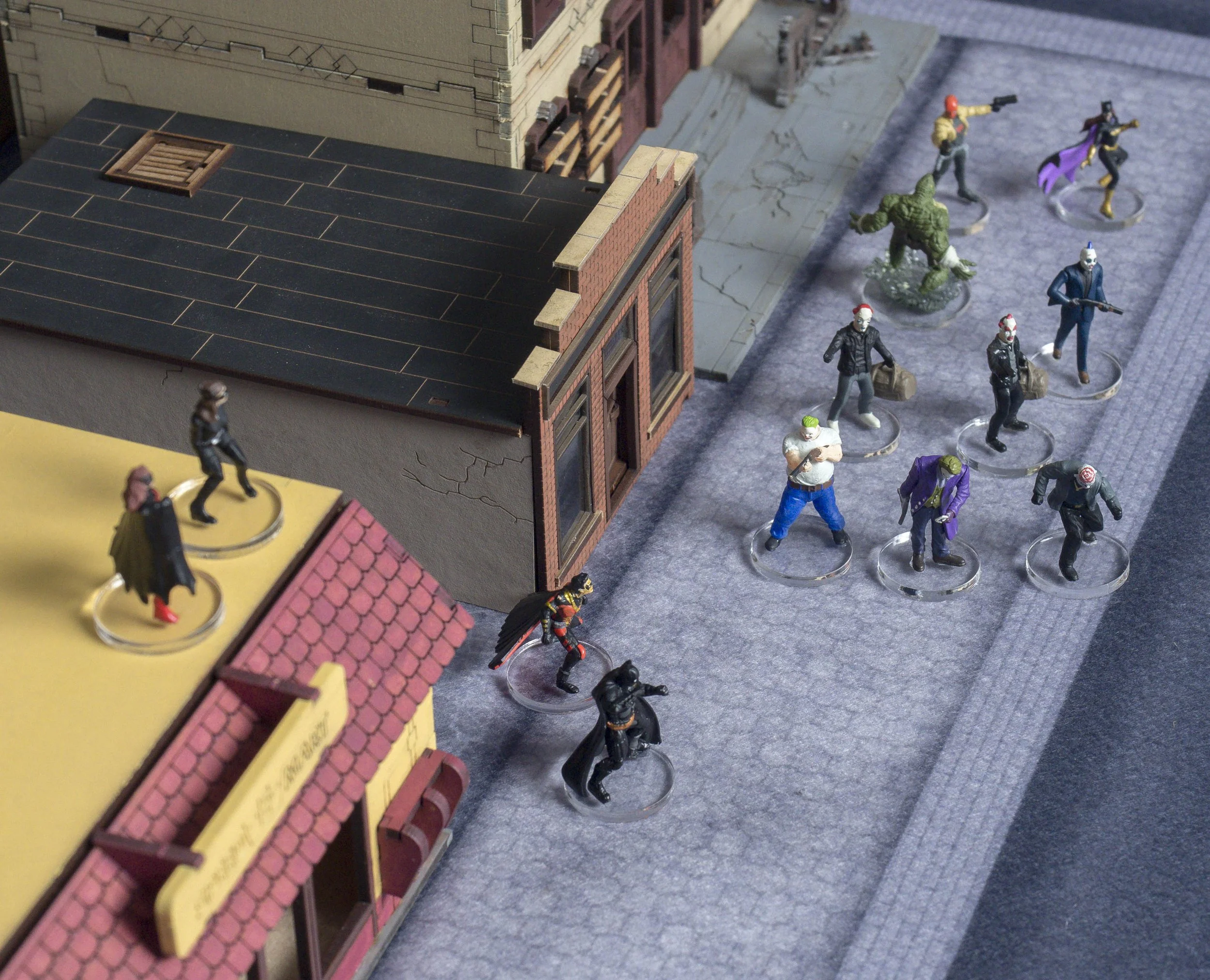
A Batman heist scenario. Batman is a 4d16 fighter with a pool power of tricks (utility belt). I managed to track down D16’s but D20’s, re-rolling when needed also work. In this scale an average character is 1d6, a thug 2d8, Joker 2d12 (with lots of special tricks) etc.
For more grounded games, it is possible to scale the game. Normals in the supers game are generally used in mook or bystander groups, with 1d/hit per figure, but in a regular level game normals may range from 1-5d and skills from d4 to d12.
If supers or other high powered characters are introduced to a normal game, effects may be stronger per dice, using fewer dice to smooth things out (and allow for more long shot rolls), such as 6d10 x5 effect.
Making power pools and flexi powers proved surprisingly simple.