D100 RPG’s are a favourite of mine, but early iterations and some derivatives have suffered from mechanical irrationalities that put me off them or forced hacking, which with D100 games is usually easy enough.
One rule in particular that always annoyed was the linear chance of a critical success or failure regardless of character skill or task difficulty, usually a 5% chance at either end of the range. This lack of nuance that the D100 system naturally offers was a waste and ignored the range d100 games could offer.
This was carried over to early Scandinavian games in a d20 form (a 5% incremental simplification of these older D100 mechanics), that eventually became Dragonbane.
I like Dragonbane…. a lot. It is light and fun, almost the perfect Fantasy RPG, especially for casual players or people wanting to escape the “norm”, but for extended play these little things will annoy me, so I will need to apply some changes or the cracks will start to show.
Ok.
In Dragonbane as written, a 1 on a d20 is always a Dragon (a good crit), a 20 is always a Demon (a bad crit). It makes the same assumption as its early BRP progenitor, a flat chance of extreme results regardless of character skill or difficulty.
This leads to these illogical outcomes;
A low skill character has the same chance of scoring a critical success as a high level character, even if their pass range is only 20% of the more skilled character.
A low skill character only has the same chance of mightily stuffing up as a near master level character.
A theoretical skill 1 test could only succeed as a crit? This one is irrelevant in reality, but still.
These have admittedly been looked at differently in newer games with various fixes, many of which can be ported to older games seamlessly.
Fixes.
The basic test.
If 2d10 are used instead of 1d20, we introduce a curve.
Reading a single “0” as 10, but 2 “0’s” as a flat “0”, this gives us a range of 0+2-19 with an average of 11 (the average of multiple d20 and a flat 3d6 rolls is 10.5, so same-same).
Skills are still capped at 18, although the odd 19 is allowed for “mythical masters”. The fail chance of a basic 18 skill test is now 3%, not 10% and with 3 as the usual minimum, there is a 3% chance of passing at that very low level, even a 1% chance of a miraculous critical.
This average sits perfectly well with the spread of skills, with most starting characters having 8-12 skills in the 10-14 range, the rest of their skills land in the 3-7 range and their characteristics average about 12 (4d6 drop 1) with a range of 3-18.
Now a curve is introduced, there is less whiff, one of the biggest turn-offs for many with linear mechanic games and the mark of a less experienced character is a tighter skill focus.
Players can even chance a less than optimal character build as any value over 11 is incrementally stronger, but this early advantage, as will be seen below, will be balanced by slower improvement.
In other words, the average test roll falls below the average characters characteristic or proficient skill value, but slightly above the normal non-adventurer NPC’s.
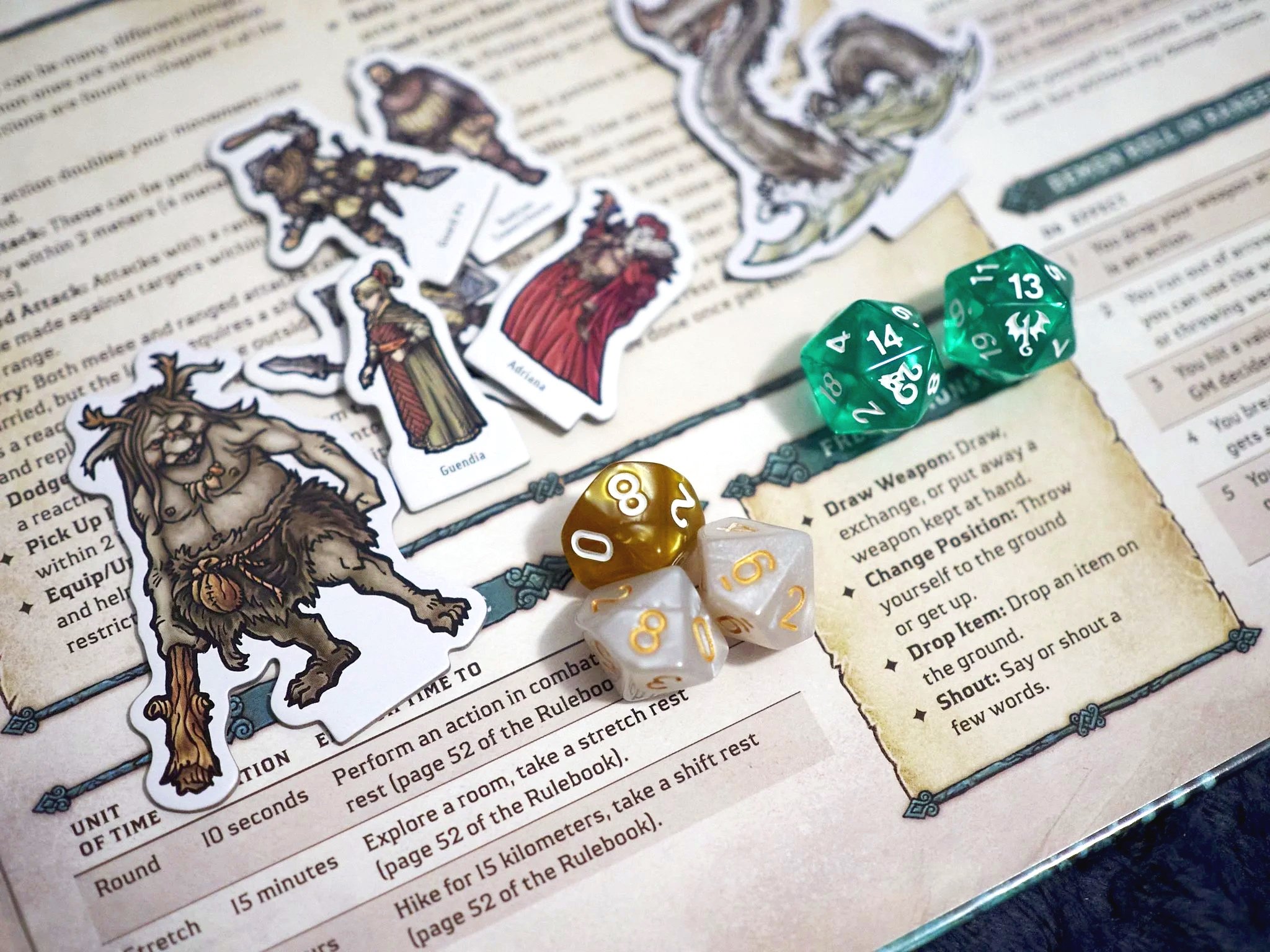
A shame to waste those cool d20’s or is it better to move on to smarter things (and maybe repurpose them)?
Critical Rolls.
Doubles are now critical effects, good ones if they pass, or bad ones if they fail the test, with a “0-0” as a flat fail or fumble (or a 20, it matters little). This is the same chance as the Dragon/Demon spread at 10% except that these are now aligned to the skill of the tester*.
I have not done the math, but instinct tells me that Boons and Banes will alter this, which is not a bad thing. Why not have an exponentially greater chance of a good critical with a Boon or bad one with a Bane.
Good skills are more reliable accessing more “mayhem”, poor ones less so, allowing for more “mirth”.
Skill 14 for example, a common starting value for a primary skill of a proficient character, go from 70% base to 79% and can score a critical pass on double 1’s through 7’s, critical fails on double 8’s through 0’s, so a 7/3 spread over the more nuanced 2d10’s possible 100 results showing through.
If it is wanted or warranted, a small table of crit effects by value can give some guidance to the outcome of rolls with high passes and low fails being more effective. A “0-0” fail would be a simple fumble or flat fail, embarrassing to a master, but otherwise quite harmless, a “2-2” fail for a low level skill test might be catastrophicas the unskilled character pushes their luck naively too far, a real “what the…..?” moment, where as a “9-9” critical pass, only possible to an already recognised expert character rolling a 1%-er would be a legendary success like taking the head off a Troll in one blow, something that players will talk about for years to come.
A skill of 14 now means that most can function more consistently in their roles only failing 22% of the time and critically failing 3%. Using a d20 means that they fail 30% of the time with a fixed critical fail range of 5%. If a character reaches skill 16 or 17, they are now considered truly exceptional and 18 is a grand master. A theoretical 19-if allowed, denotes a legend of their time (but still not infallible), needing an advancement roll with a 2% chance of success.
Boons and Banes.
This also changes the Boon/Bane mechanic and slightly softens it’s overall spread.
A Boon is applied by adding a third (or more) dice, then taking the best combination of two (players choice).
A Bane is applied by adding a third (or more) dice, taking the worst possible combination (which may be a critical fail, fail or a lower/non critical opposed pass roll etc).
As shown below, the actual Boon/Bane odds hardly shift, but the range does soften slightly*.
Advancement.
With a curve introduced to the advancement roll, there is a speeding up of skill improvement at low levels and a slowing down at higher levels with the balance point at 11. Characters can “round out” poor skills they take an interest in easily enough, usually by comically failing, a very Dragonbane vibe, but extremely high skill levels become vanishingly rare. A venerable character in their “Master” phase would have 1-2, 18 level skills, but probably time to retire.
The chance of improving skill 14 to 15 with the 2d10 curve is 21% as opposed to 30% with a d20.
Even numbered skills become mini milestones as they switch a critical roll from bad to good, a real feeling of breaking through to a new level of expertise which again aligns with the char-gen system (specialist proficiencies are always even starting values).
In the game as written more seasoned characters get more skills, not higher levels in their existing proficiencies, which leans directly into this thinking. The designers are even hinting that once a solid proficiency is reached, a character will more naturally “round out” their skill set rather than hyper-focus in on a few skills at their expense.
I like this improved depth but slowing of growth at higher levels, it feels like a more significant achievement balanced with a generally stronger showing of medium high skills. Faster improvement of low level skills gives an incentive to try possibly unwise, but play enlivening tests, which now almost act like activating flaws do in other RPG’s.
Opposed rolls.
Using “the lowest roll wins” for opposed tasks means the lower skilled character actually has the same chance of succeeding when they roll these lower winning values, ignoring the larger range the higher skilled character has. Yes, their chance of rolling a success is lower, but their chance of succeeding when they do is the same.
They may only have a skill of 3, but any time that is rolled it has a better than decent chance of beating the vastly more skilled level 16 character who still succeeds by hitting most of their range. This means the higher skilled character is basically sweating on the lower skilled character failing their role, not the other way around.
It is an odd dynamic.
Logic would dictate that the only time that lower skilled character should win, is when the higher skilled character fails or less often they both pass, but the lower skilled character still wins with a higher roll.
The highest passing opposed roll should be the winner, because it shows an exercising of greater mastery. This is in the face of the basic tenant of the game, that a lower roll is always better, but so be it.
This all makes more sense!
So;
A curve is introduced, effecting the Test and Improvement rolls respectively, but in balance.
Critical rolls are now skill aligned, but the overall chance of an exceptional result is the same.
Opposed rolls are now “highest passing roll wins”, in line with skill values.
The Boon/Bane mechanic is different but the outcomes much the same.
The main thing is, the game will be the same for all.
Will it break the game?
I have crunched the numbers and yes, if two identical sessions were compared using the two different systems there would likely be a mathematical difference in outcomes, the new mechanics making starting characters feel slightly better at what they do well and weaker at the things they are less familiar with and that will also be highlighted in their growth path, but I am going to predict that the changes will actually align better with the Dragonbane “mirth and mayhem” vibe.
*Looking at the spread of 2d10 compared to the D20 version is revealing.
At skill 11 the spread is balanced at 29 with a Bane/55 standard/78 with a Boon, as compared to 30/55/80 with a d20, but the spread in either direction changes considerably. At skill 8 it is 11/28/53 vs 16/40/64, so clearly tougher for a low skill test, but at skill 14 it switches to 57/79/93 vs 49/70/91, an advantage now to a higher skill character.
This has to be weighed against the improvement roll and the skill aligned critical chance spread with the reverse of the above values in effect.
There is the option of reading 0’s as 0’s, but the odds lean heavily in the characters favour.