My first science fiction love was Star Wars, the original movie, first time round the block when I was about 10, watched at the beautiful old the Princess Theatre Launceston. I can even remember (roughly) where I sat, up in the stalls left hand side.
I went in with I know not what expectations, possibly none, I certainly don’t having remember any, but I came out changed.
Science fiction that looked real, looked like it was the history of another place, lived in, like it actually happened, not the weird, super clean, strangely fanciful fiction I had seen up till then.
Star Trek came later, a constant flood of series from various generations, filling the void Star Wars left between the original trilogy and the things that came later, movies I did not even bother with until recently.
I found Trek a little boring at first. The old stuff was old and looked it, I viewed it like a teenager looks at a child, too close to their own recent past as to feel familiar, but alien, the newer stuff was that clean, unlikely future I had rejected in the past.
It grew on me. The big ships, variety of encounters and sheer saturation won in the end and Star Wars became the “other one”, a world of pulp fiction and many series I had little awareness of. Somehow Star Wars lost it’s special place, it revealed its simpler ideas and less developed story lines for what they were, pure Space Opera.
Ok, the point.
I bought into Star Trek Attack Wing early to get into a game type that was not admittedly my preferred style (pre-painted, semi board game), but an itch that needed scratching and going AW meant avoid the larger commitment of the more popular X-Wing. I also knew more about it and familiarity is a thing.
X-Wing still happened, then Armada, both just completed as their respective games wound down. They became an obsession and I even sold off some Attack Wing to help soften the blow of chasing some weird and rare X-Wing and Armada ships.
That was a mistake.
If I could wind the clock back, I would have avoided X-Wing all together or stuck to my guns of only doing the TFA period (bought cheap on clearance), something the 2e upgrade packs would have perfectly fit with and also probably avoided Armada or more likely avoided the Prequel sets where I started. These were never completed, which still annoys.
That would have let me complete my AW range which was still clicking along in the background (missed the Romulan, Borg and other Faction packs and 3rd Dominion War solo set, now going for hundreds) and chase up some OP’s when they were plentiful. I would also have kept what I had and ended up with, I think, a more enjoyable game for a casual and non-competitive player.
Why is AW better in my eyes?
It’s not the minis, they are all over the place in quality, paint job and scale*. Unlike XW, the ships are actually secondary to the cards, which may sound odd, but this will make more sense as we explore further. They are however robust on the whole. XW ships can die easily on the table, AW ships are mostly bullet proof (Enterprise Refit-looking at you).
It’s not the core game play, because AW uses basically the same system as X-Wing. There are differences which we will get into, but at the heart of it, it is the same core game bought under license.
Opinions vary as which theme bests suits the mechanics better, but I feel the subtle mechanical differences allow both to fit the game perfectly, or at least differently.
So, what is it?
The AW game straddles an interesting place between the small ship X-Wing dogfight and huge ship Armada fleet battles. AW gives you the feeling of flying a larger ship, one less agile than in X-Wing, but also one that is “squishier”, more robust and deeper.
The dials and Action bars are less interesting, but that also matters less. Manoeuvre is important, but unlike X-Wing, not all important. In XW, Actions are all important and add to the zippy, darting and weaving fighter vibe. Ships like the Interceptor or A-Wing rule their “space”, at least until upgrades to other ships even out the field.
In AW, Action bars are much less about repositioning manoeuvres, only offering Cloak and Sensor Echo (a great handling of cloaking), or Regeneration.
Captains are separate from ships, meaning vastly more variety up front, a Captain, named ship and Elite Talent provide a triple synergy and there are often multiple choices of better known Captains.
This can lead to odd combinations in open competition play, so again, sticking to timeline and faction limits helps make it feel right.
There are more upgrades, especially named Crew. X-Wing tends to be a Pilot/Elite Talent/payload squad build with “Action chains” all important. The second edition worked to reduce that dynamic, but it is still there. It does a great job of simulating that single seat fighter fragility and it’s dynamic with larger ships, but AW has a different feel.
In AW, there are near countless combinations of exceptions, mitigations and additives, all designed to give you the feel of ensign “X” saving the day by pulling off a miracle manoeuvre or fixing a used/broken/stolen/”not installed til Tuesday” upgrade. Some upgrades can even be added “just in case” and used to absorb unpleasantness if needed.
It is, as I eluded to above, a “squishier” game, with fewer alpha strike and premium build options, less of a “I have the most agile ship until you upgrade to be my equal” and is more aligned to scenario play. The need to build to adapt to what comes rather than build to outgun at the start. There is a community and they do have ideal builds, but if you avoid the free-form space, you can make almost anything work and stick to theme.
The core sets are another prime example of the difference in the games.
The X-Wing core provides about a third of a competitive squad for each side. One X-Wing vs two Tie Fighters was never meant to be a competitive set, only a start with about 30-35 points a side. As bought, it is crying out for more and some major figures in the franchise are missing, like Vader.
XW needs several ships just to make a squad, many of these coming with upgrades that are ship limited and quickly you are staring at a 10-15 ship collection just for needed variety. Want three X-Wings, that’s a Core or two and one or two expansions and while you are getting them you are building up Tie Fighter squads (up to 8), like it or not.
The three capital ships in the old AW Core set can provide multiple combinations, you get Picard and two other named Captains, plenty of named Crew, named and plain ships. The upgrades can be mixed freely if you so desire, even a three way game can be played.
Although there are not enough ships for a 100pt competition squadron (unless you combine them), the game is not so hung up on that, it is ok with a 50 point build (x3 in the set) and a decent scenario (also in the box). It has far more options than the XW set provides and for many probably enough.
Building an AW fleet is a matter of adding maybe 1-2 more ships to the three factions you have started or looking wider, which provides plenty of options and tactical directions, each ship coming with enough upgrades to open up a myriad of tactics, even within a faction.
For a brief moment, I had retained a small TNG period representation of all the factions (2-3 ships) and I was actually happy, but then I got the fever again when clearances started to appear. Clearance cost you money, it’s a thing.
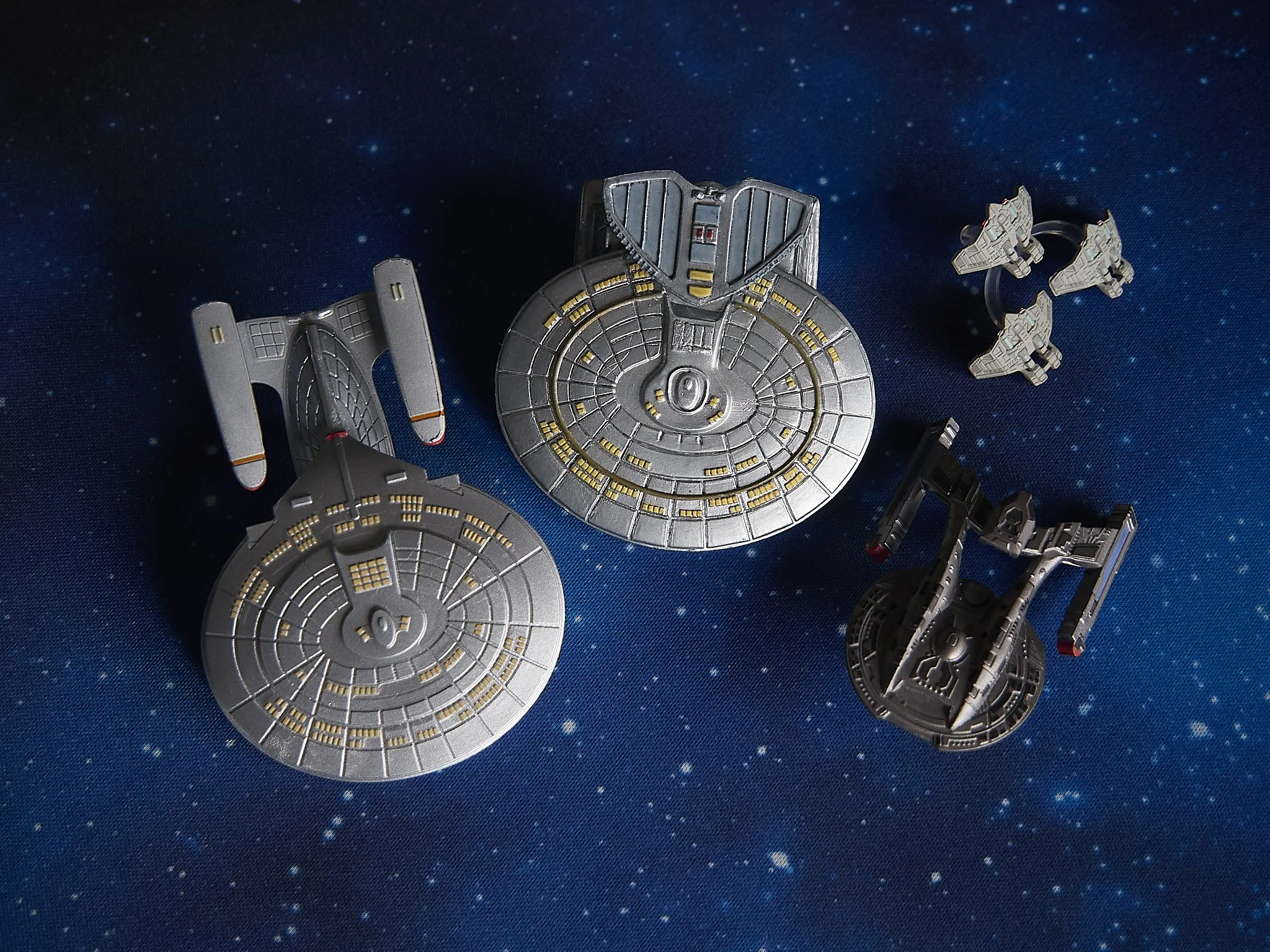
This was actually pretty satisfying, a small TNG fleet for all the factions made up of single representative ships and select cards after my clear out. It did not last.
Story telling is integral in AW, each ship coming with a scenario and many faction packs with a short campaign. XW has only started to support this in later iterations, to their detriment.
When I want to play AW, my mind goes straight to a scenario idea, a mini story. When I play XW, I build a 100pt squad (still playing 1e here) and have at it. Oddly, scenarios in XW are often popular, but only appear in later releases or off book.
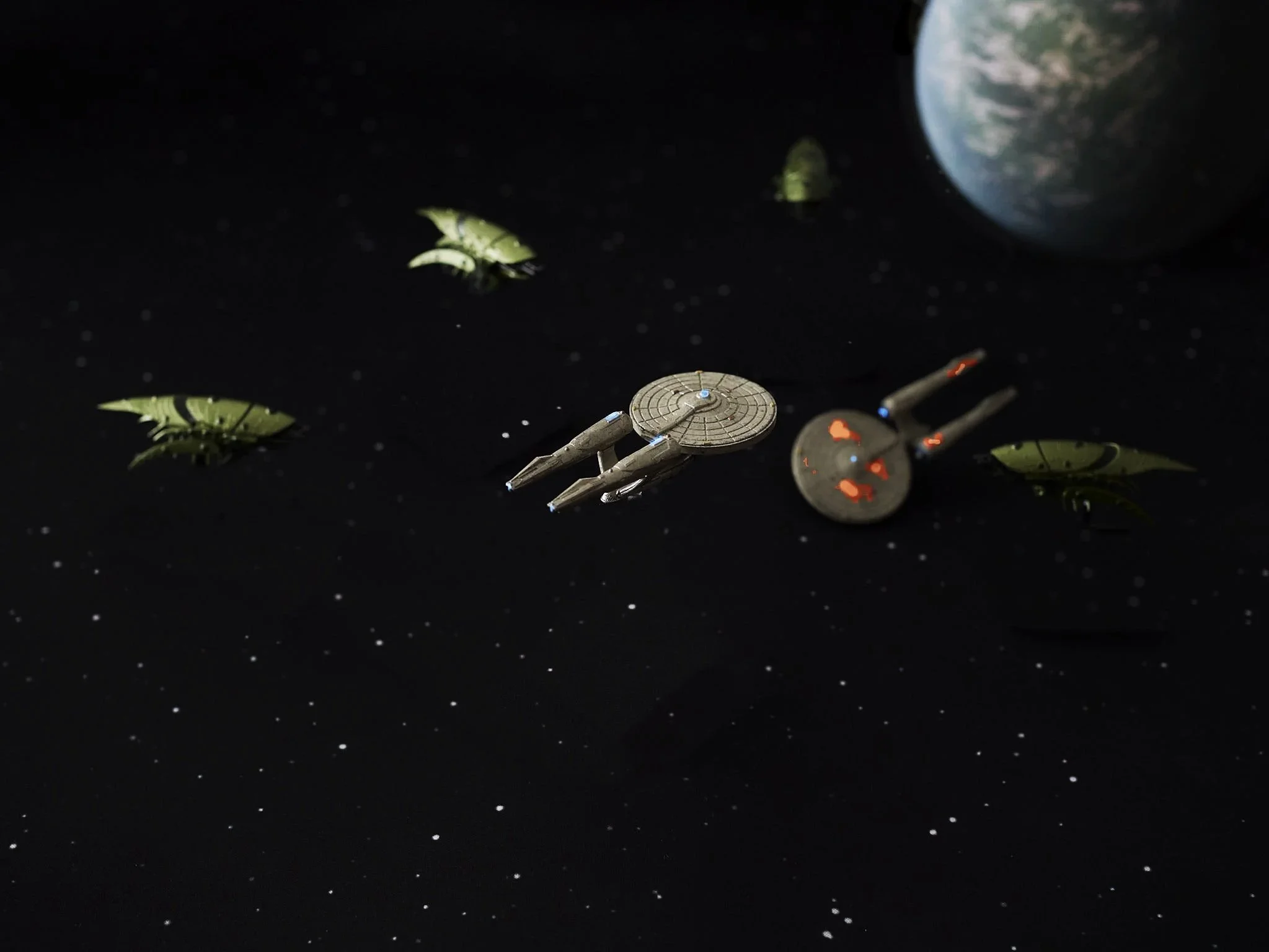
I see a story here (probably a short one), something XW needs to have added. This is a rare but plausible departure from canon.
The range of personalities available are many more in AW and they mean more (contentious), but every Captain or Crew card adds a personality and a face. In XW, the Pilot is basically a ship, the Crew far fewer in choice and available slots and as often than not, they are generic.
In AW Crew is everything, which is as it should be. X Wing 1e has issues with Crew like Leia Organa being an over priced ability available only in an expensive Huge ship expansion. In 2e there are sometimes overwrought and convoluted abilities.
It is safe to say, I prefer the overall dynamic of upgrades in AW.
I have lists of XW upgrades I pore over, most committed to memory, but in AW, there are so many I don’t even try. Most upgrades in AW are bespoke, be they Tech, Crew, or Elites, there is little repetition in Weapons and that is down to the reality that there are not many weapons in Trek and unlike XW, there is little “added” by the designers, Trek I guess offering more to cover.
Weapons are needed of course, it’s a combat game at heart, but they do not dominate. In AW, it is logical to take Torps or their equivalent, maybe something more faction aligned, but you can fly a decent game without. Ships are tougher, mistakes less precipitous, other things matter as much or more. The Enterprise*** of any era is not strong because of an Action bar or Weapon upgrades, it is Crew that makes the difference.
In XW, ordnance is much more varied and can be brutal, but it is often a one-shot strike.
Something AW also does well is disabling of upgrades, not spending and removing them. XW 2e did add the “charges” mechanic and 1e some half baked ideas, but AW has always allowed Photon Torpedoes to be replenished, or busy Crew cards to be re-enabled. It fits the theme and makes for a longer lasting game.
The Elite Talents are similar, but with Captains and named Ships also sporting abilities and most Talent being unique, the mix is softer and more flexible, there are literally thousands of combinations.
Many EPT and Pilot combinations in XW are often not even considered optional and create very powerful combinations used in multiples, something AW avoids with more choice and less repetition. In 2e as there was little point denying them, many combinations even became standard.
Tech is a good way of upgrading any AW ship, Sensors, Mods, Droids, Illicit do this in XW, but are limited and there are clear favourites.
It is not for nothing I cut back 1e upgrades in XW, not using EPT’s, Mods or Titles, which just seem to even out the field and de-throne the stand out ships. In AW, the overall softness of upgrade effects and the less brittle ship abilities defuse this, basically I obsess over one, barely give the other any thought.
Edition wars are less painful. No 2e mass-migrations, just some annoying point value changes*, a polishing of the core rules and clarification of some exceptions. Wizkids were not as tight in their roll-out of AW as the XW custodians were, but the game was also less brittle by design.
It is a gentler introductory game. For all the reasons above, AW is a soft landing, a fun afternoon, no sign of gamesmanship or power building early on, no sudden death choices and if you avoid competition play with its “anything goes” dictum, every upgrade can find a home.
A last thing and something I will happily own as mine and mine alone is hacking AW cards. Thanks to the bespoke nature of many Crew and Ship cards, you get a lot of excess and repeats when you build larger fleets, but thanks to cosmetic consistency, it is easy to cut and paste (literally, not technically) and increase your choices. I have built up decently deep genre sets using this technique, like more than doubling the ship choices in my Kelvin set, reusing otherwise wasted Mirror sets which were cheap and plentiful in the later stages, even filled some holes, like a missing Chekov in the TOS range. By my count, I have probably 200 more ships, Crew and Captains than I originally bought.
No, they will not stand up to competition scrutiny, but yes, they do add to the game for casual play.
Your milage may vary, probably does on average as XW is by far the more popular game, but for me AW was where I went first and looking back was where I should have stopped.
It is still my obsession, even after stripping my collection bare and going again, even after spending more on both Armada and XW respectively.
I will keep my X-Wing and Armada collections, why would I not, but AW is the favourite.
*I fix this by keeping my fleets to strict faction and timeline sub-sets, even splitting DS9 and TNG and some repaints. One thing that I am always aware of is the fragility of many X-wing ships. They are lovely, but I have spare X-Wings for a reason. Simple and chunky AW ships rarely suffer from this concern.
**I have mostly dealt with the PV’s by keeping to faction limits and making a choice on either dearer or cheaper values, “hacking” cards as needed.
***A great example is the humble Enterprise NX (pre-Federation), on paper a Tie fighter at 2-3-3-0, but add four Crew (with Archer) and with them some more Weapons and Tech and that little ship can stick around for a while, not “pop” like a swarmer Tie. You can have 8-10 abilities on that little ship, the Tie gets a Pilot, maybe an EPT and Mod.