About 15 years ago, or maybe more, I have a series of game ideas, I bought figures, started the laborious (pen and paper era) task of writing and re-writing rules, you know, the stuff you do when a hobby consumes you.
Things were settled in many ways. I knew what I wanted in the scale of the games, the feel and look, even the mechanics in many ways.
So, what happened, what went wrong between there and here?
The first/main problem as I see it has been one of priorities. I have been trying to write the perfect rules before I have finished the figures, or more to the point I put the rules cart before the figures horse. This means that I had written myself into oblivion, never settling or being able to “visualise” the end product.
The fact is, I like toy soldiers to look like that, little men doing their thing in nice scenery, which is what got me into the hobby in the first place, but many games require element basing, and although that is admittedly easier in many ways, I struggle to commit and my analysis paralysis has become habitually cyclic.
Too many options, too much second guessing, too many reviews and unfortunately buying other peoples rules, only to cherry pick out a few ideas and add them to my own. Such is the hobby I guess. Some follow a path with conviction, many hesitate to their peril, neither is wrong or right.
Part of my issue is and I know this to be true, that I do not play in others “sand pits” as often as I should which not only clarifies preferences and highlights dislikes, but it also takes the preciousness out of the process.
I know players who will ignore unpainted figs, inconsistent basing (or even scales) and happily sub-in completely inappropriate figures or even don’t use figures at all, just to get a game going. I could learn from that.
I don’t and it shows.
WW2 games in particular are vexing.
I like “old school” singles and tend to lean towards “naive” toy figure gaming. Respected and excellent systems like Dave Brown’s “O Group” or Battlefront WW2 are better at simulating the reality of war, but not always the wargame I want to play. The closest I have come to the perfect simulation using element bases is Crossfire, but these also have issues.
Singles look right to anyone, but require more handling and some dual moulded and crewed weapons do not play well here. Guns can be used by multiple armies with the crew provided separately, figures fit into terrain and generally look natural, even if some games require a lot of accepted abstraction in scale to succeed, like Rapid Fire at 1:15 scale, a single tank or two figures representing a platoon.
Team or section bases are more mechanically sound with a single element being a command, casualty and combat unit, the actual fig representation meaning little and dual moulded and crew weapons are absorbed naturally, but the game tends to look a little board-gamey.
Visual abstraction, or abstraction of scale?
So much consternation over so little?
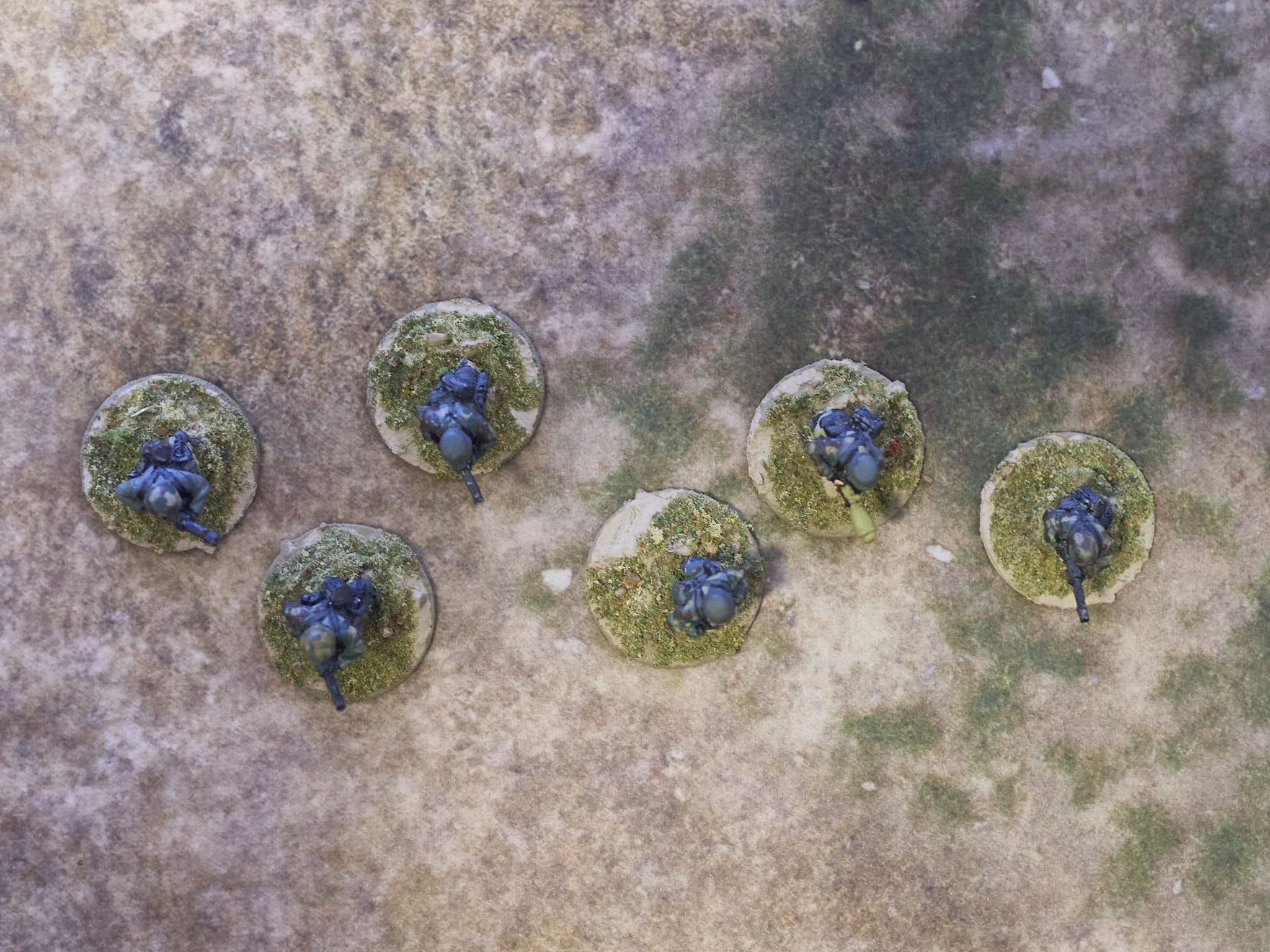
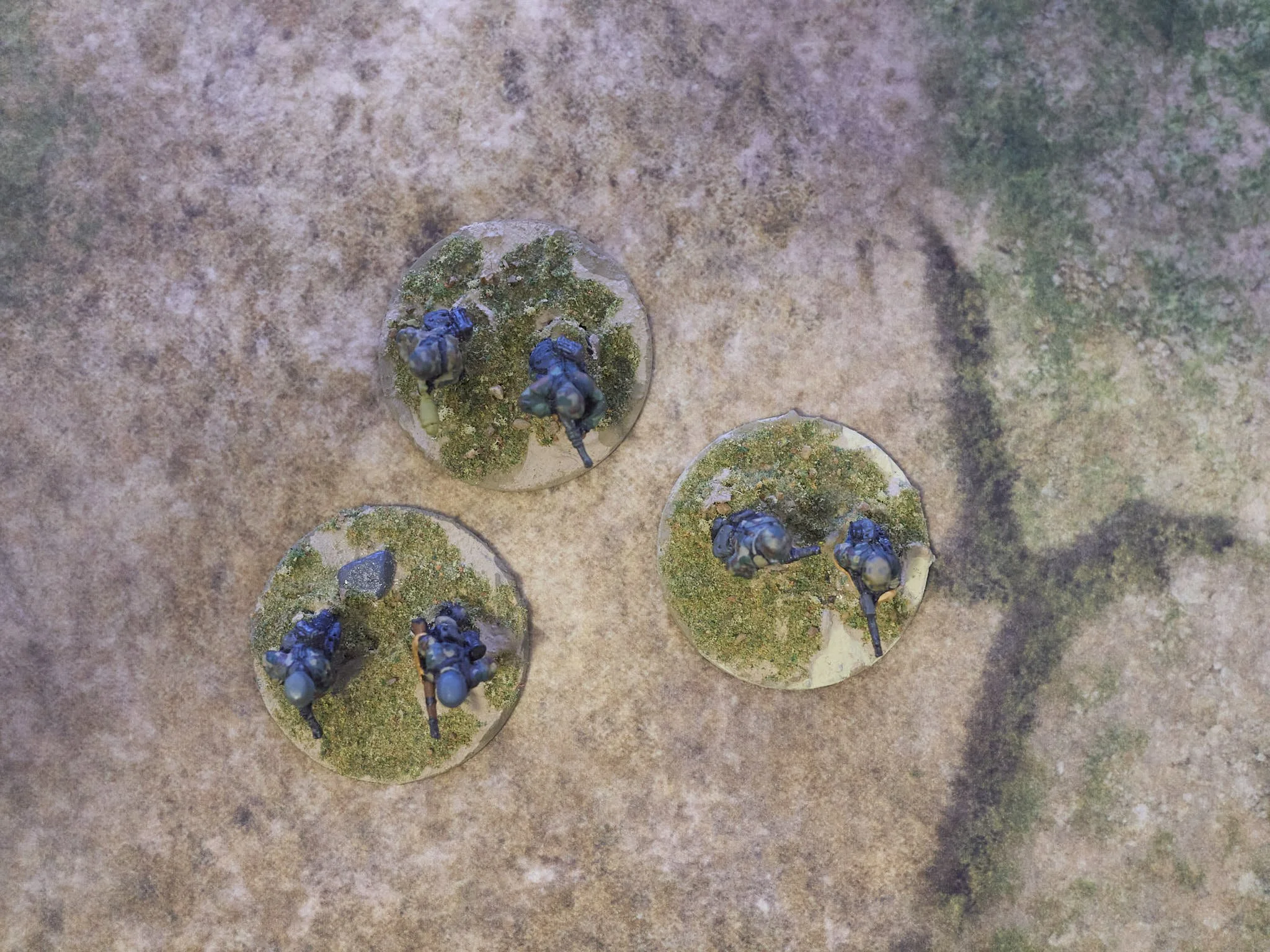
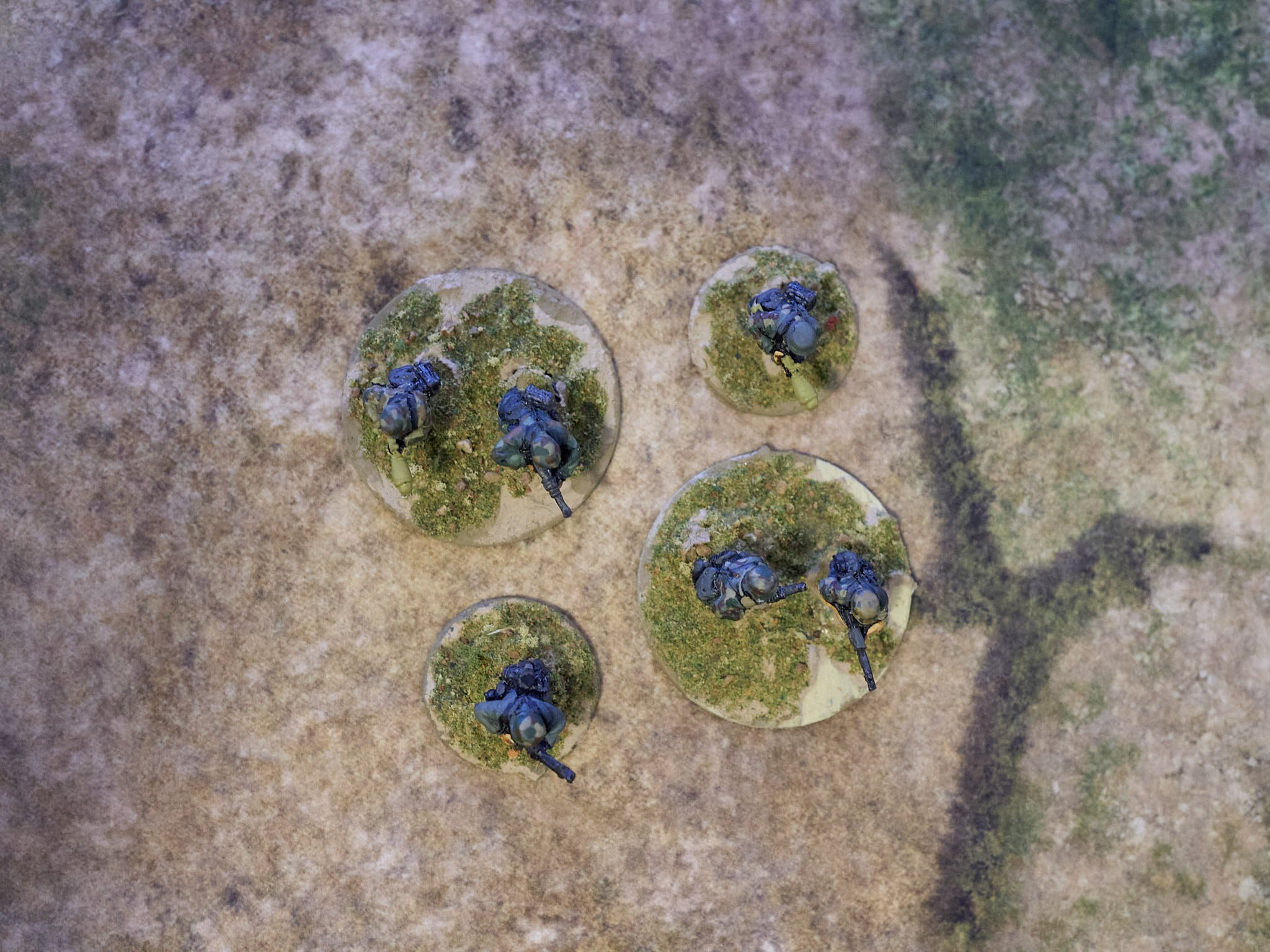
Which sells it better, 6 loose figures, 3 dual fig elements, a mix of both? Also a chance to look at the new “Fields of Glory” mat from Geek Villain.
I think I actually like the 1-2-2-1 look as it seems denser, maybe more interesting and it sits better with dual moulded figs. The other factor of course is does the platoon have to be fixed? It is a group of figs from a parent company, so it might be more, might be less.
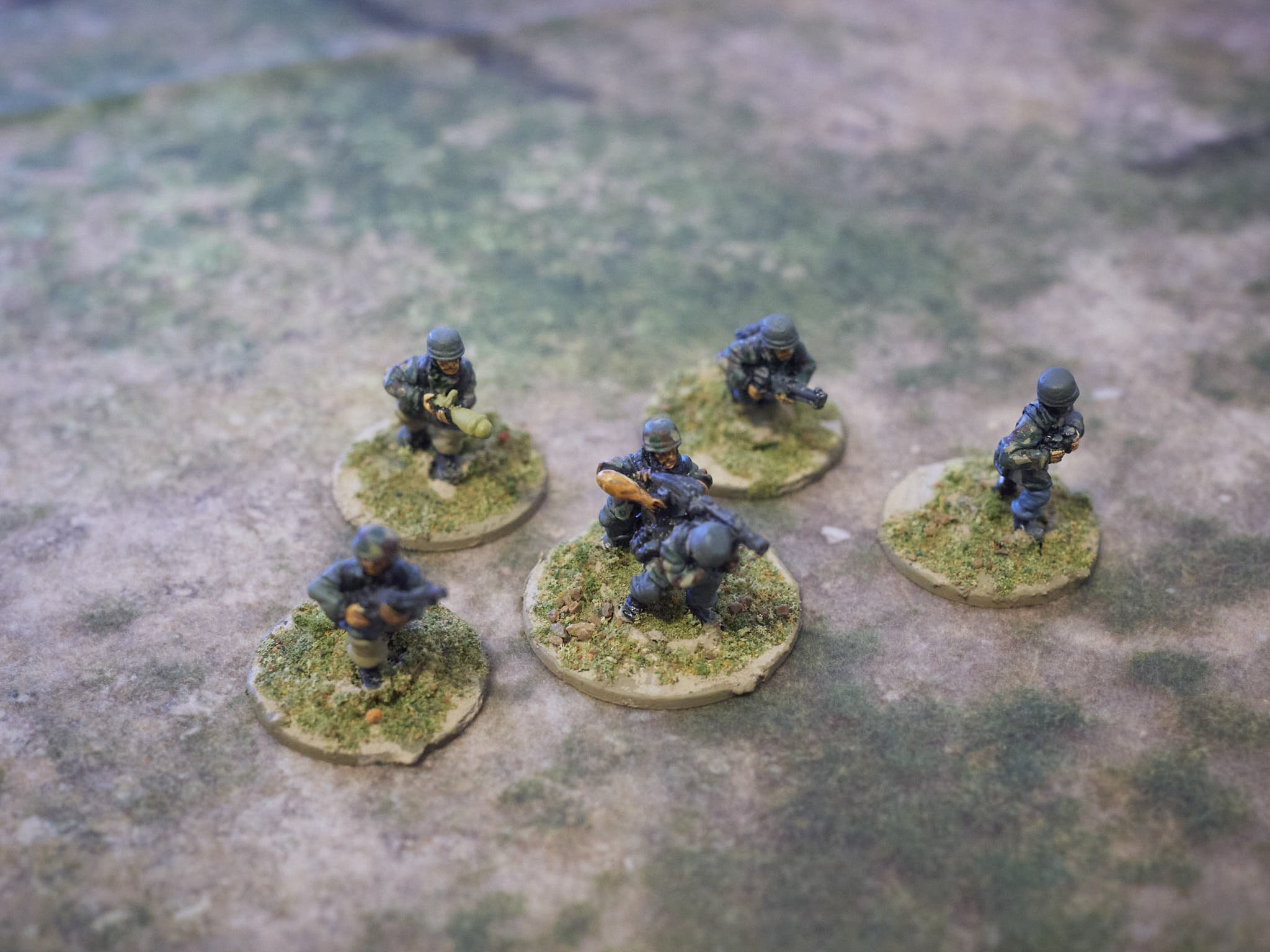
5 that are 5 or 6? Maybe better with a mix.
The various abstractions and practicalities cut both ways.
Something that surprises me on reflection is that a loose gathering of figs as a platoon can often be less mechanically weighty than controlling each individual element on its own, so to simplify that, I have basically written the same system for each, the mounting of the figs being the only point of contention and at the same time effectively irrelevant.
Singles mean the circumstances of every figure can be resolved on it’s own for determining cover saves etc, but the whole unit can fire as an abstract group and the effects of morale applied to all. Elements just make each base a discreet “figure”, so fewer active bits on the table, but also larger attrition “steps”.
Apart from handling, minor mechanical differences and scenery fit, I am hair splitting really, it makes little difference, it comes down to what I want to be looking at and the core family of mechanics I will be adhering to most.
A mix of the two (1’s and 2’s) helps with handling and terrain fit, but it looks messy, no matter how much I try to convince myself otherwise.
My Britannia 20mm WW2 collection was meant to be used as 1:5 scale Rapid Fire-like games, 6-8 figure platoons acting as the tactical unit. In RF, I cannot vibe with the 1 Piat for a Battalion thing and my bought figs fit into my OB’s in number only, not specific weapon representation.
Britannia figs have two clear divisions for my needs. One group have dual moulded and linked together crew served weapons, another sub-set have figures that can all be mounted totally independently (USMC, Ger Jaeger, US Rangers) with no “joined” figs.
The 1:5 company (platoon units) feels closer to the look and feel of the game to me than the 1:15 battalion (company units) and I prefer a battalion sized overall battlegroup to a larger force (usually, I dabbled with 1:10 for a while, 12-18 fig companies sitting quite well).
Then I looked at maybe element based Crossfire (at teams level) with my smaller unit forces. I really wanted to do teams level modified, which fixes a few scale abstractions in that game I have really come to dislike, but again, figs as bought did not fit that mould, so to speak (not enough LMG’s for one).
Turns out, I have basically flipped this to small unit singles and large unit elements.
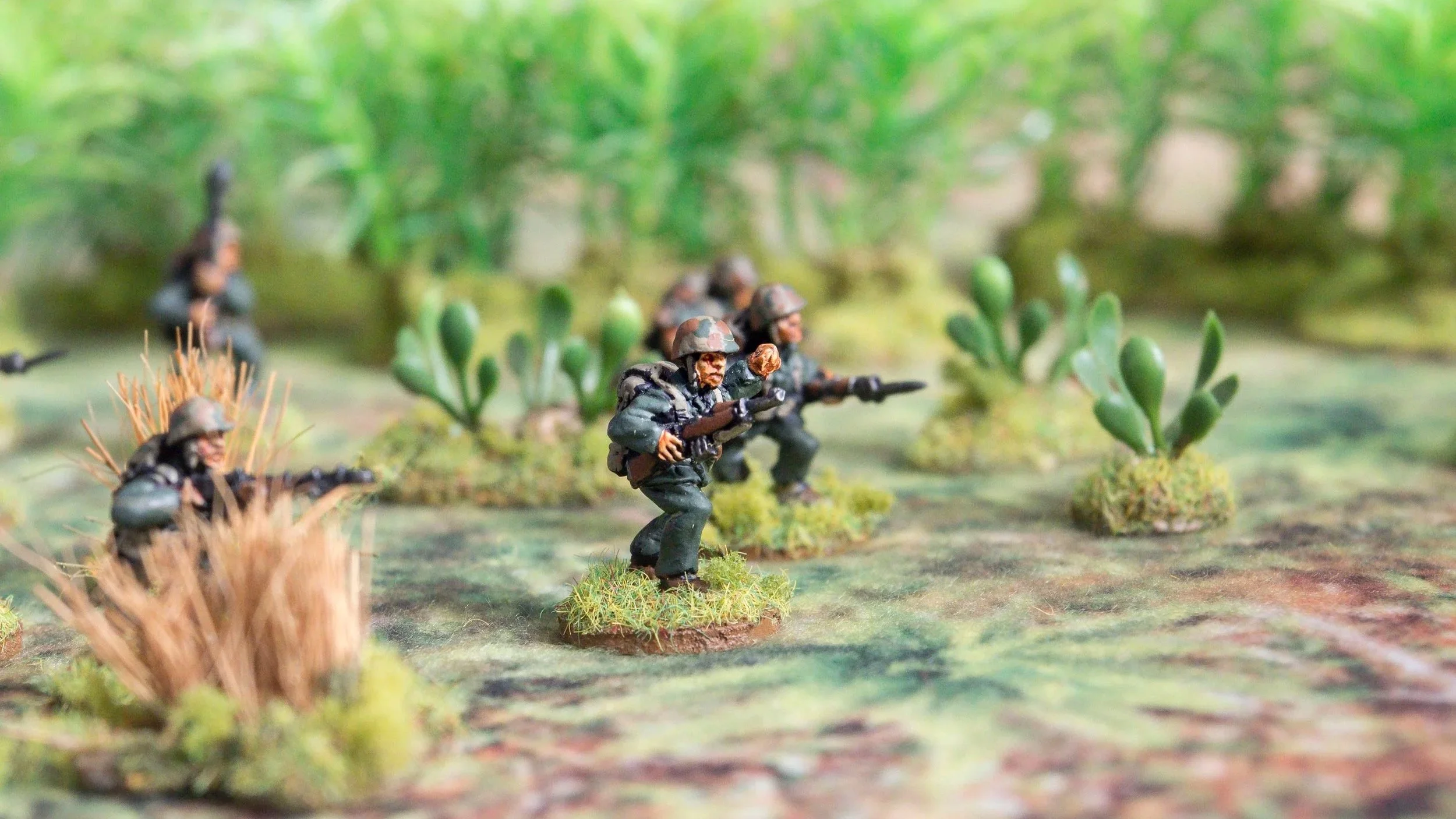
Some small unit games like my Vietnam, Pacific, winter in Stalingrad/Berlin and Commando raider games are fine as singles and can give me my “old school” fix and some of these are already done, but the larger scale 1944 western Europe “operational” games are where I bog down. Importantly, these look right don’t they?
My lean is towards a platoon of a mix of single and dual figs for larger units, making a platoon unit acting as one with various conditions applied. This might or might not include attrition and removing figures.
The company is the actual command unit, bases just being grouped for initiative and combat efficiency into patrols, platoons and detachments.
I could also do my CF teams game at a pinch with sabot bases. If I want larger units, I can still mix in my singles and most singles games will allow these with casualty markers.
Next.
My ECW 28mm figs were to be in diorama based regiments or battalia, using Principles of War or a similar regimental level game with no figure removal. POW was not a perfect fit, but it felt like a good starting point, maybe slightly down scaled, more tactically nuanced, some other bits added for flavour.
Plenty of figures painted or partially so, then nothing.
The 28’s have a partner in my less exotic but more numerous 18mm Museum ECW set all mounted for DBR or any number of other games, so these are able to handle the bigger armies and battles. My more varied 28’s seem well suited for a semi-skirmish scale, the small wars like Cornwall, Wales, Scotland.
The Pikeman’s Lament got me excited, then not as the game is too loose and small scaled for me, it lacks the right feel and I struggle with some mechanics. Very Civil Actions by the Perfect Captain with a major re-write, or a set of my own making. TPL is still an option, I just need to look at some annoyances like scale, fig removal/unit condition and a lack of pike blocks.
My 28mm Gripping Beast Arthurians were to be the same, diorama bases like the old GB adds I fell in love with at the time (MW-early issues in the double digits) and an unknown set of rules.
I managed to get 40 odd figs painted a lot more started, have mounted and re-mounted them and maybe I have settled on Dux Bellorum and my preferred game with large diorama bases.
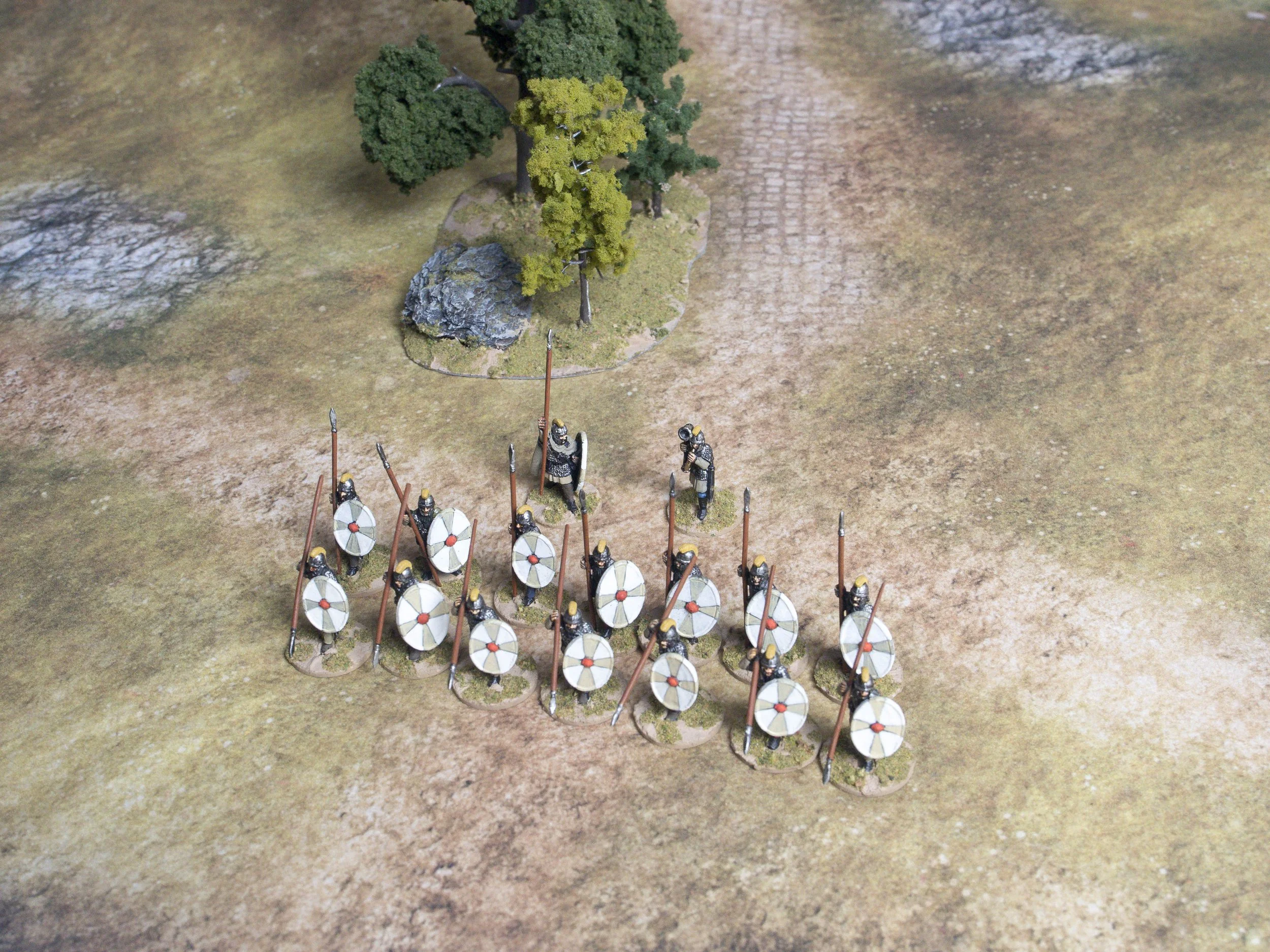
Yep, don’t get comfortable boys, the bases maybe are coming off….again. It does seem a shame to re-base them but it turns out on inspection, I have already started.
These three, the worst offenders and my guilt spaces over the years have become habitually ignored.
The rules;
Always mount figs for the most flexible application of rules and scales. Think of them more as a flexible resource, not a cement shoe one game choice.
As long as they suit your desired look, because if you don’t like the look of them, who cares in the end.
This may sound like a contradiction, but it is possible.
What does it mean in real terms?
Mount almost all figures for singles games then use sabot bases as needed.
My operations level WW2 figs will all be mostly mounted as singles for games ranging from 1:1/3/5/10, then sabot bases can be used to suit various more “modern” element based games.
Some units will have no duals and be mounted as singles, which makes them ideal for skirmish level games. Any issues raised by moulding etc can be sorted, they always have been.
I already have sabot bases made and have even used them successfully.
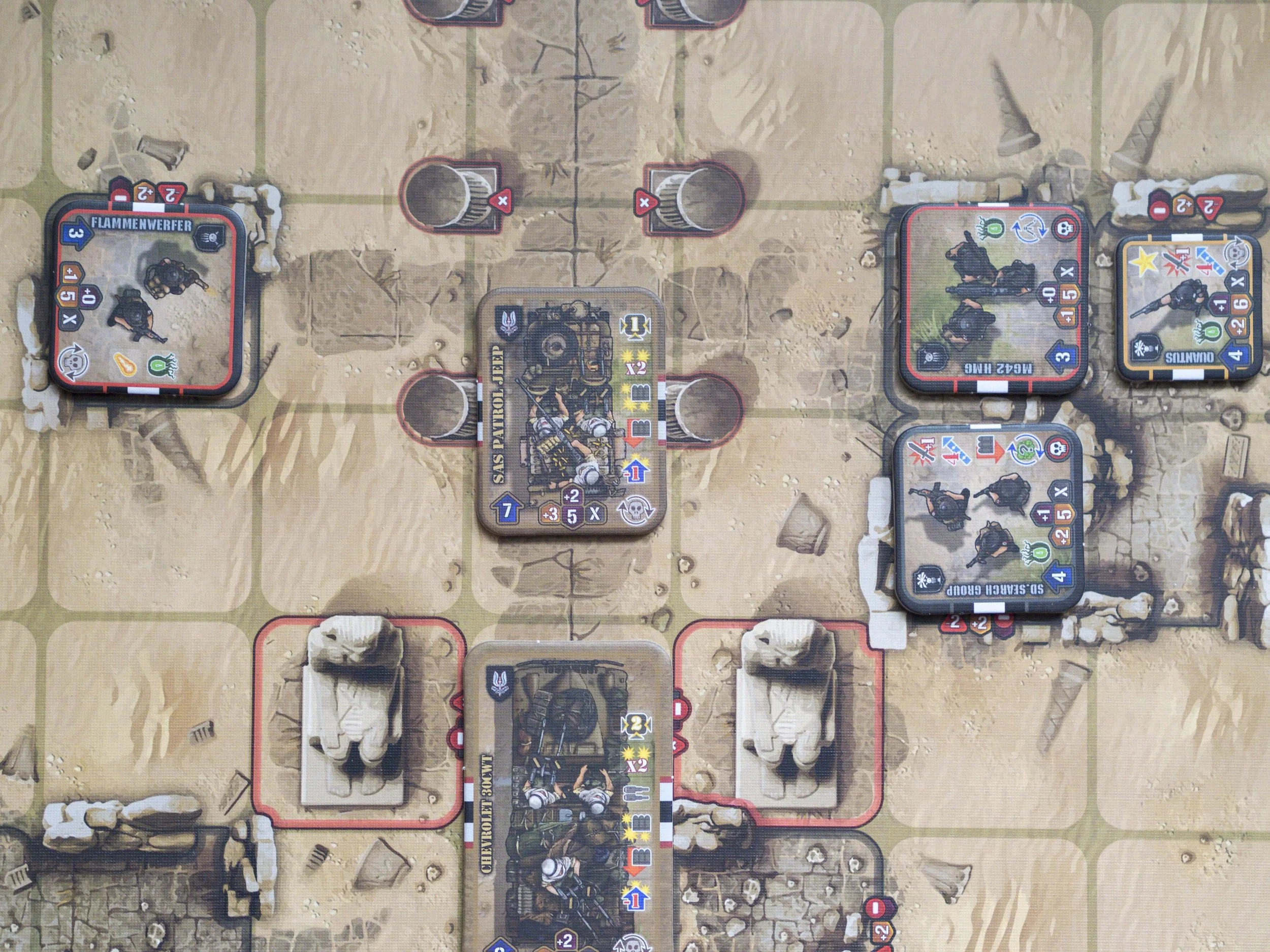
I love this game, it is as close to a minis game any “flat” game has every been for me, but when my minis start to look like that, I am less enthusiastic.
Coins may also be used as bases as ironically, metal coins cost less than plastic bases and give more heft. The cheapest bases I can find as plastics come in about 10 to a dollar , so the same as a metal 10 cent piece or over $1au for a 40mm!!!!. Ed. some wooden bases, 200 for $10 have been found.
This means that most forces will have 30-160 odd combat elements on the table depending on scale and the rules depth will decide what that means. Rapid Fire for example can handle a 1:15 brigade, Chain of Command a 1:1 platoon with supports, a simple system of my own can do battalions at 1:5. I will intend to have coherent OB’s for specific units, a “best use” option as many were bought to be 1:5 battalions or 1:1 skirmish, but plenty of flexibility from there.
The reality is, most element based games can be played with clumped singles and element bases severely limit how harmoniously the figures fit with their scenery (hate that leaning base look or sitting on top).
Every set of rules I have can be used from 1:1 Chain of Command or Bolt Action to Rapid Fire at 1:5 or 1:15 to Battlefront WW2 or Cross Fire on sabot bases or just clumped.
So,
Looks good
Fits all uses as a resource, not painted (or mounted) into a corner.
Ok, next.
My 28mm ECW figures will be mounted 3 foot or 2 horse on a 40 to 50mm square base, a departure from circular, which surprisingly I find too irregular and bulky to form cohesive units in units of 2-6 bases.
I was sorely tempted to go with singles again, then use diorama sabot bases but there are really no singles-only based games I want to do in this period.
This might be a size thing, my 45mm circular bases not clumping together convincingly with the convex edges pushing figures apart too much and looks like success relies on some 1’s and 2’ to fill gaps and the assumption of small scale “mobs” at skirmish level, not arranged units. Ideas I had for circles allowing a less rigid formation have given way to the need to actually be able to form them.
Also, after cutting and hand carving a dozen circles with irregular edges in hard 3mm foam, with still about 80 to go, I think it would be easier to cut squares and there is nothing to say my squares have to be perfectly regular, or the units perfectly lined up, or the figs rigidly placed. I can then also use movement trays.
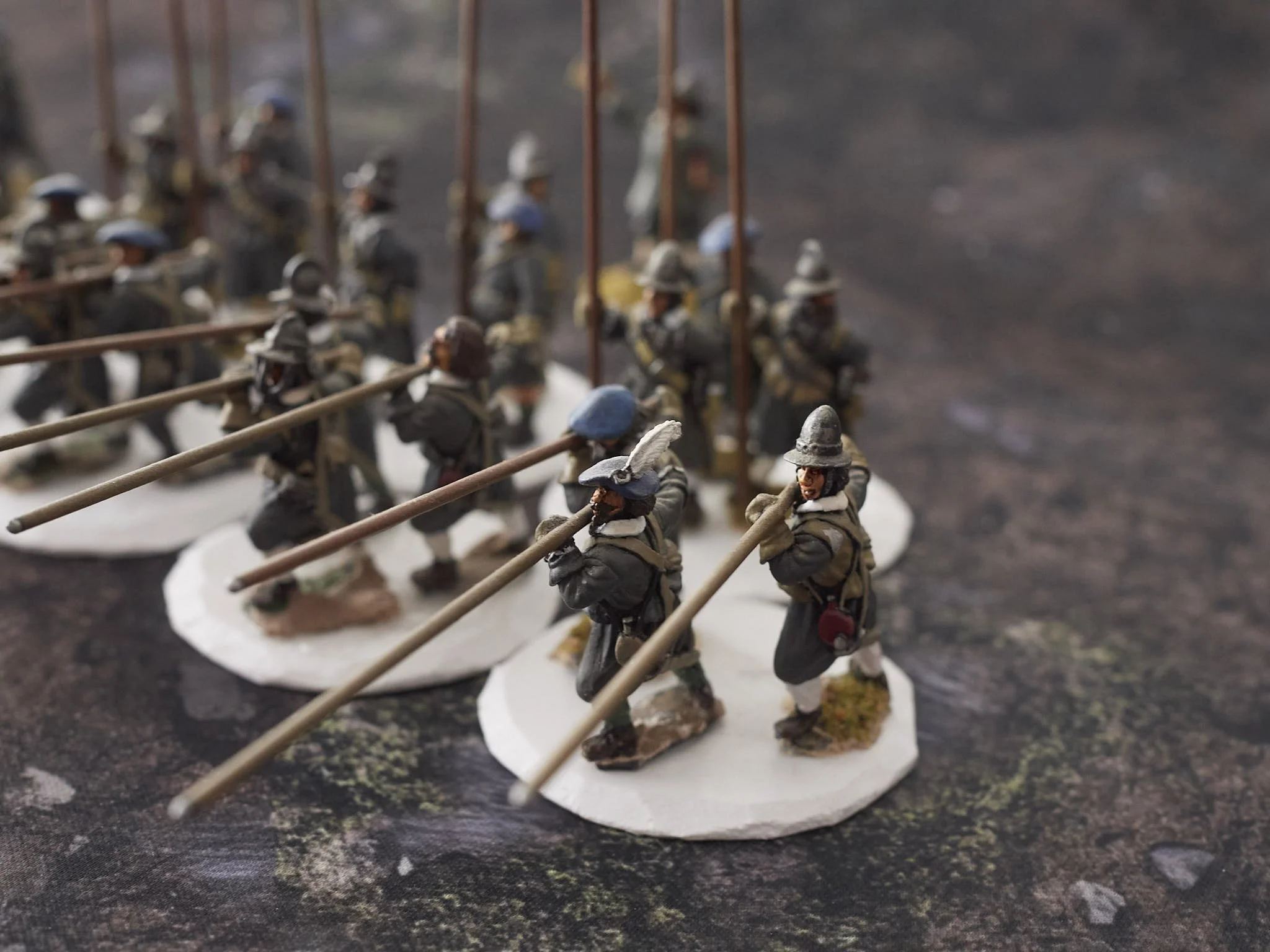
Yet another mounting idea, this one for Pikeman’s Lament, which I have gone cold on and it turns out, the big circles are of limited value for convincing formations or most other games. I do like the 3’s, 4 figs looking too parade ground perfect.
This means I can use (re-written) VCA, modified TPL, my own rules, several of which have been penned, and any other rule sets capable of smaller, skirmish-like actions like FH, WHECW or P&S. At worst, I would need some casualty markers, at best they are ideally suited in regular elements.
My 18mm ECW will remain on DBR bases as I have started them, which suit every large scale rule set I have (PoW, VWQ, Forlorn Hope, P&S, DBR, FoG).
The 28mm Arthurian armies might not go this way, not even singles with large sabot bases. I have some mounted as singles right now, but doing my original intention of diorama bases is still appealing on several levels.
Fixed diorama bases reduce flexibility, increases handling risk (dropping a fixed base of 6-9 figs could be heart breaking) and it requires commitment to a base look which may not match all my mats. It also forces scale and abstraction and scenery becomes partly irrelevant as bases will move around it, but not into it, but the reality is, I like them for this scale and they are the norm for Dux Bellorum.
They look lovely, but are not overly table practical and I can mimic them close enough with good sabot bases (which can be done to suit several scenery styles), but I will go with them for this period alone.
This is a case of the exception that proves the rule, a commitment to one game and staying the course.
My sabot bases (many already made) will not be the perfect circles-in-the-hole type, but harmoniously edged ones with a “clearing” in them for bases of many sizes and any density.
Sorted? I really hope so. I just ordered 300 25mm circular bases.
If not, the next option is gifting the lot and moving on.
*This would suit not only these rules, but also other rules and I could also take my Dark Ages Viking figs and use them for the same game.